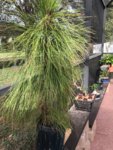
In short...Yes...I think these are a viable species for bonsai...the respond beautifully to the typical JBP training techniques. Needles are long but I am quite confident that length can be managed once the tree reaches that stage of development. Great bark that forms relatively quickly. Can be extremely vigorous. Susceptible to all of the same diseases, insects, and environmental stresses. Back buds well for a pine....but not as well on old wood as say Pitch Pine.
In long...

This species is closet to JBP in terms of care and is capable of 2 or more flushes of growth in a season. That said I am using my own development techniques that probably don't jive with other folks' ideas about how these trees should be developed. My intentions were not so much to create great bonsai but to learn whether this species is even viable for bonsai training and which techniques are most successful.
I have been playing with some coastal loblolly seedlings that were leftover from an arbor day give away at my elementary school about 6 or 7 years ago. I planted some as a wind block on the edge of my property and the largest of those are now pushing 15- 20'. I took another group and planted those into 1 gallon nursery containers....with traditional nursery potting mix. After a couple years they were tall enough that the least little wind knocked them over. I planted them, pot and all, into a growing bed to eliminate the constant falling over and to accelerate growth by letting roots escape into the ground thru the nursery container.
Since being in the growing beds, I have only been hedge pruning these trees... at least twice a growing season. When I hedge prune, I typically cut back to a branch that still has healthy needles but not necessarily any buds showing. They respond with a nice new flush of buds at the base of existing needles and often with buds further back on older branches. In my climate, and I suspect yours, I think you could easily push 4 flushes of growth in a season( I pruned 3 times in 2013 and 2014 and twice in 2015).
As these trees have continued to grow, they have gotten too close together... so I have had to dig and reposition some to provide more space to insure low branches don't get shaded out. I moved(chopped all roots growing outside of the container, left the trees in the 1 gal pots and replanted) some in the Fall and some in the Spring...all survived and all experienced a significant slow down during the following growing season...as one would anticipate. I removed one entirely from its container and pretty mercilessly chopped its roots last fall and planted it directly back into the ground...it hardly missed a beat...a little slower getting started this growing season but it is finishing well.
They seem to be a little less prone to needle cast but more prone to insects such as scale, aphids, and bud worms. That said, the tops of my are extremely dense currently which I think is adding to the current insect problems... Once the trees start more concentrated training I suspect this problem with decrease significantly.
I have not collected any but I would suspect the easiest path would be to collect the smallest seedlings you can find and start from scratch.
I will most likely begin moving some of these from the ground into training containers (I will probably use Anderson flats) in the next couple of weeks. I will begin more traditional training with these trees once they have settled into their new containers.
That is about the extent of what I know about this species currently