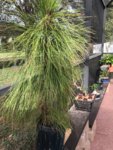
Pinus taeda

Ceijay

Mame
Messages
199
Reaction score
215
Location
MS
USDA Zone
9a
I live in Mississippi so I have loblolly pines everywhere, and I mean everywhere! Mostly I am interested in the seedlings which are all over my back yard year round. Unfortunately I know almost nothing about pines or evergreens. They don't have leaves, they don't drop their foliage in winter, something about candles???

Anyway, I'd like to seed/collect some loblolly stock and focus on learning about this species. I suppose my first few question are:

What kind or pine is this? Is it a white pine, a black pine or something else?
When can i collect it in the wild since they don't drop their leaves in winter?
What kind or plan should i have for seedlings - saplings?

Any additional information would be great as well. Thanks.
 
Welcome to the forum, i love pines (they only don't love me back).
 
Welcome to the forum, i love pines (they only don't love me back).

Yeah I figure with loblolly I could slay a yard full and have just as many to slay again next year. I'll get the hang of it eventually.
 
CJ, taeda is one of the under used pines in the country. It's neither "black" or "white" it's a 3needle pine and a vigorous grower. Collecting seedlings and 2 or 3year old is easy and the older they get the more care should be taken with collecting. Starting in Feb. for southern Ms. and Mar. for the north, take a trowel and loosen the soil around the tree and gently lift them. Cut the tap root and plant into a well draining soil. Water well and keep semi-shade for a few weeks and then move into full sun.
 
In short...Yes...I think these are a viable species for bonsai...the respond beautifully to the typical JBP training techniques. Needles are long but I am quite confident that length can be managed once the tree reaches that stage of development. Great bark that forms relatively quickly. Can be extremely vigorous. Susceptible to all of the same diseases, insects, and environmental stresses. Back buds well for a pine....but not as well on old wood as say Pitch Pine.

In long...:)
This species is closet to JBP in terms of care and is capable of 2 or more flushes of growth in a season. That said I am using my own development techniques that probably don't jive with other folks' ideas about how these trees should be developed. My intentions were not so much to create great bonsai but to learn whether this species is even viable for bonsai training and which techniques are most successful.

I have been playing with some coastal loblolly seedlings that were leftover from an arbor day give away at my elementary school about 6 or 7 years ago. I planted some as a wind block on the edge of my property and the largest of those are now pushing 15- 20'. I took another group and planted those into 1 gallon nursery containers....with traditional nursery potting mix. After a couple years they were tall enough that the least little wind knocked them over. I planted them, pot and all, into a growing bed to eliminate the constant falling over and to accelerate growth by letting roots escape into the ground thru the nursery container.

Since being in the growing beds, I have only been hedge pruning these trees... at least twice a growing season. When I hedge prune, I typically cut back to a branch that still has healthy needles but not necessarily any buds showing. They respond with a nice new flush of buds at the base of existing needles and often with buds further back on older branches. In my climate, and I suspect yours, I think you could easily push 4 flushes of growth in a season( I pruned 3 times in 2013 and 2014 and twice in 2015).

As these trees have continued to grow, they have gotten too close together... so I have had to dig and reposition some to provide more space to insure low branches don't get shaded out. I moved(chopped all roots growing outside of the container, left the trees in the 1 gal pots and replanted) some in the Fall and some in the Spring...all survived and all experienced a significant slow down during the following growing season...as one would anticipate. I removed one entirely from its container and pretty mercilessly chopped its roots last fall and planted it directly back into the ground...it hardly missed a beat...a little slower getting started this growing season but it is finishing well.

They seem to be a little less prone to needle cast but more prone to insects such as scale, aphids, and bud worms. That said, the tops of my are extremely dense currently which I think is adding to the current insect problems... Once the trees start more concentrated training I suspect this problem with decrease significantly.

I have not collected any but I would suspect the easiest path would be to collect the smallest seedlings you can find and start from scratch.

I will most likely begin moving some of these from the ground into training containers (I will probably use Anderson flats) in the next couple of weeks. I will begin more traditional training with these trees once they have settled into their new containers.

That is about the extent of what I know about this species currently:)
 
In short...Yes...I think these are a viable species for bonsai...the respond beautifully to the typical JBP training techniques....

Wow that's the kind of information I'm really wanting. Thank you so much.

Would you say that the needles reduce well for a small or forest planted bonsai or should it be kept large like the way you would a wisteria?

And if I'm going for a bunjingi style like they grow in nature would you still recommend hedge pruning?

Thanks again for the great info.
 
What kind or pine is this? Is it a white pine, a black pine or something else?

Something else. If you want a color call it yellow pine for the wood. White pines are named for the stoMa on the needles all have 5 needles per bundle btw, as opposed to 3 for lob lolly 2 for the black pines,

I'm not sure why black pines are called black, they both have dark green needles my be that's it
 
Wow that's the kind of information I'm really wanting. Thank you so much.

Would you say that the needles reduce well for a small or forest planted bonsai or should it be kept large like the way you would a wisteria?

And if I'm going for a bunjingi style like they grow in nature would you still recommend hedge pruning?

Thanks again for the great info.


...i know the needles will reduce...it remains to be seen how short....for now i would work toward finished trees in the 2+' size....it looks like mine will work out to about 30-42"....but i like tall trees!

Personally I am in favor of hedging the trees during development as it produce tons of choices when it comes time to style. Even if you are planning for a shape with few branches....its always better to have choices! If you hedge to your envisoned future silhoutte for a couple years....when you are ready to style...all of the branches and foliage are within the shiloutte and can be easily selected, wired for shape, and opened up to the sun for future development.

Hedging may be a controversial training technique in some camps, but I find it to be the most effective way to get a great jump start on material in preparation for more selective pruning and development. None of my trees are even close to finished so i hedge prune a lot of things!
 
Thanks for the tips. I'll be taking a look through your youtube channel as well. :D
 
In short...Yes...I think these are a viable species for bonsai...the respond beautifully to the typical JBP training techniques. Needles are long but I am quite confident that length can be managed once the tree reaches that stage of development. Great bark that forms relatively quickly. Can be extremely vigorous. Susceptible to all of the same diseases, insects, and environmental stresses. Back buds well for a pine....but not as well on old wood as say Pitch Pine.

In long...:)
This species is closet to JBP in terms of care and is capable of 2 or more flushes of growth in a season. That said I am using my own development techniques that probably don't jive with other folks' ideas about how these trees should be developed. My intentions were not so much to create great bonsai but to learn whether this species is even viable for bonsai training and which techniques are most successful.

I have been playing with some coastal loblolly seedlings that were leftover from an arbor day give away at my elementary school about 6 or 7 years ago. I planted some as a wind block on the edge of my property and the largest of those are now pushing 15- 20'. I took another group and planted those into 1 gallon nursery containers....with traditional nursery potting mix. After a couple years they were tall enough that the least little wind knocked them over. I planted them, pot and all, into a growing bed to eliminate the constant falling over and to accelerate growth by letting roots escape into the ground thru the nursery container.

Since being in the growing beds, I have only been hedge pruning these trees... at least twice a growing season. When I hedge prune, I typically cut back to a branch that still has healthy needles but not necessarily any buds showing. They respond with a nice new flush of buds at the base of existing needles and often with buds further back on older branches. In my climate, and I suspect yours, I think you could easily push 4 flushes of growth in a season( I pruned 3 times in 2013 and 2014 and twice in 2015).

As these trees have continued to grow, they have gotten too close together... so I have had to dig and reposition some to provide more space to insure low branches don't get shaded out. I moved(chopped all roots growing outside of the container, left the trees in the 1 gal pots and replanted) some in the Fall and some in the Spring...all survived and all experienced a significant slow down during the following growing season...as one would anticipate. I removed one entirely from its container and pretty mercilessly chopped its roots last fall and planted it directly back into the ground...it hardly missed a beat...a little slower getting started this growing season but it is finishing well.

They seem to be a little less prone to needle cast but more prone to insects such as scale, aphids, and bud worms. That said, the tops of my are extremely dense currently which I think is adding to the current insect problems... Once the trees start more concentrated training I suspect this problem with decrease significantly.

I have not collected any but I would suspect the easiest path would be to collect the smallest seedlings you can find and start from scratch.

I will most likely begin moving some of these from the ground into training containers (I will probably use Anderson flats) in the next couple of weeks. I will begin more traditional training with these trees once they have settled into their new containers.

That is about the extent of what I know about this species currently:)
What johng said. I started working with loblollies a few years ago, because I love pines but have remained unloved by them through the decades. Even JBPs die in my care, and they're supposed to be pretty hard to kill. But loblollies seem much more resilient and much faster to train than any I've heard of or tried. As johng said, you can get three or four flushes of growth in a single year. And this makes them much faster to train than other pine species. I did my last 2015 candle-pruning of one specimen I'm working on last month, and it's responded with more buds. Also, needles get shorter as continued pruning makes them denser. So yes, you definitely need this species in your collection.

Zach
 
I have a bunch of seedlings- just volunteers that I kept alive... I cannot let them die after all! Insanely merciless chopping- even removal of all viable buds back to old needles on young/ not very strong plant, repotting out of season, dropping off the bench in a wind storm, slapped back into the pot with a little dirt tossed on top just to cover the exposed roots, HARD wiring and twisting... I haven't found much that would kill them! One seedling was a little tiny thing I had been running over with a lawn mower for about three years, growing my sandy/ clay yard... It was about an inch tall with 1/16th of an inch long needles at three years old (AT LEAST) that age... And just for "fun" I dug it and stuck it in a pot with some potting soil- it EXPLODED! Grew to a full on 2 foot seedling with 6-8+ inch long needles in one season- a year and half later and two growing seasons and it has expanded it's trunk to about a half inch, even with pruning and wiring.. I have young ones so I haven't done much to reduce needles, but I will probably start working on that wi a few int he next couple years... Pretty excited about them!
 
@johng


Id love to see them too!

Sorce
YES PLEASE!:) I already spend hours on here searching through any posts that have images attached. Mr. @Zach Smith has three images of two trees listed under his pine pre-bonsai stock, one of them is sold unfortunately.

I have a bunch of seedlings- just volunteers that I kept alive...

Great. I really love plants that can take harsh treatment. They will provide excellent test subjects.

Speaking of harsh treatment I know that it was mentioned that a healthy tree can take a sever root pruning but what about soil? Can anything be gained from giving it a poor soil, like a cooler nabari or a growth response ( I'm thinking of wisteria again because they like being root bound to encourage blooms )?
 
July 2014... I had let them get away a little...over 6' tall
IMG_0737.JPG

IMG_0738.JPG


From today...

IMG_0047.JPG

IMG_0049.JPG
 
Wow those are fantastic. I think they are way too large for what I'm going for but I will apply your technique to my seedlings and see what happens. i'm super jealous of your material garden.

Thank you so much for sharing.
 
July 2014... I had let them get away a little...over 6' tall
IMG_0737.JPG

IMG_0738.JPG


From today...

IMG_0047.JPG

IMG_0049.JPG
You can see in the background of the second pic some of the Shimpaku he has been growing out for a while too... Not to change the subject, but I feel you are growing out are spectacular John! I appreciate the cuttings you gave me this Spring too! From that bag about.... 25-30 rooted! :) Thanks man!
 
I have a recently collected loblolly. It’s an a small nursery container with its native sandy soil. The needles are beginning to brown. I had it in full sun for a short time now it’s in partial shade. I water when temps get above 80. Should I keep it as is or repot into a training container with pumice?
 

Attachments

  • 8F6F9162-36F0-4F08-B4D0-00C5EBB0BB82.jpeg
    8F6F9162-36F0-4F08-B4D0-00C5EBB0BB82.jpeg
    460.9 KB · Views: 18
  • AF5FD04F-7206-4F1D-978F-8DF5C6EAA628.jpeg
    AF5FD04F-7206-4F1D-978F-8DF5C6EAA628.jpeg
    614 KB · Views: 18
Back
Top Bottom