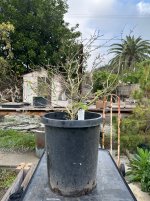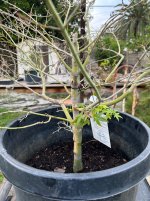
Starting an AP Hanami Nishiki in a grow box

David P

Mame
Messages
141
Reaction score
265
Location
Southern California
USDA Zone
10A
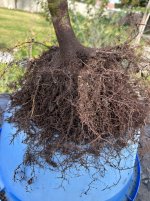
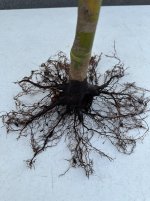
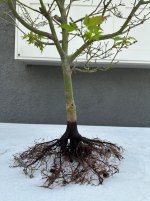
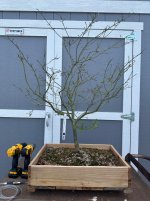
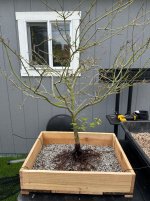
Hello BNuts, I am starting this tree's journey in a grow box. It has spent its entire life in nursery containers, most recently in a 15-gallon container. I did a hard root prune to improve the nebari and repotted it in this grow box I built. It's mid-February, and it's still dormant here in So Cal. The key question is: can I safely perform heavy structural pruning to thick branches I don't need and pruning on branches I do want to keep back to internodes or buds that are closer to the main trunk? Or should I wait until it leafs out and the leaves harden later in spring?

As always, thanks for your help.
 

Attachments

  • IMG_1500.jpeg
    IMG_1500.jpeg
    593.9 KB · Views: 91
  • IMG_1502.jpeg
    IMG_1502.jpeg
    499.2 KB · Views: 86
  • IMG_1504.jpeg
    IMG_1504.jpeg
    494.3 KB · Views: 67
  • IMG_1505.jpeg
    IMG_1505.jpeg
    633.1 KB · Views: 70
  • IMG_1528.jpeg
    IMG_1528.jpeg
    426.6 KB · Views: 66
  • IMG_1535.jpeg
    IMG_1535.jpeg
    400.5 KB · Views: 68
  • IMG_1540.jpeg
    IMG_1540.jpeg
    517.7 KB · Views: 68
  • IMG_1649.jpeg
    IMG_1649.jpeg
    488.3 KB · Views: 95
When I see Catalina date palms in the background, I know what's up :)

Here's the bigger question - how kind is Southern California going to be to your Japanese Maple? It is a tough environment for them, not cold enough, with howling dry desert winds. Make sure you have a protected environment in your yard with shade and wind cloth... and make sure you are using RO or softened water... else you may be in for some heartache.

To your question - since you already did significant root work this spring, I would not touch the tree again for at least a year.
 
Did you just now perform the root pruning? Thats where all of its stored energy was. It might have trouble coming out of dormancy this year.
 
When I see Catalina date palms in the background, I know what's up :)

Here's the bigger question - how kind is Southern California going to be to your Japanese Maple? It is a tough environment for them, not cold enough, with howling dry desert winds. Make sure you have a protected environment in your yard with shade and wind cloth... and make sure you are using RO or softened water... else you may be in for some heartache.

To your question - since you already did significant root work this spring, I would not touch the tree again for at least a year.
Hi, I don't live in the desert; I live between Orange County and downtown LA. I have other JPM's that do fine where I live, but yes, I just did the root work 2 weeks ago.
 
Did you just now perform the root pruning? Thats where all of its stored energy was. It might have trouble coming out of dormancy this year.
2 weeks ago. Ive seen others cut the roots even more severely than what I did. I thought deciduous trees could handle that sort of root pruning.
 
Yeah, I have also seen way more drastic root pruning on J. maples. Plus, the tree looks like it's coming out of dormancy (leaves and visible buds).

I think by desert wind, he was referring to the Santa Ana wind events. That's when you need to protect the J. maples. Also, protect in the height of summer from heat + sun.
 
2 weeks ago. Ive seen others cut the roots even more severely than what I did. I thought deciduous trees could handle that sort of root pruning.
They can handle a lot but timing is key. When deciduous trees drop their leaves and go dormant, the tree is storing it's sugars and energy in the roots. In the spring, those sugars are pushed back to the branches and buds to fuel that years flush of leaves and growth. If the tree is still dormant (buds not swelling) and the roots are removed, then you are removing its only source of energy.

If I were a betting man, I would say at the very least you will get significant branch dieback as the tree tries to balance available fuel with the correct number of leaf buds. Or the growth will be very weak. And the tree wont grow new roots until there are enough leaves to photosynthesize energy from the sun.

Keep it protected and you should be fine. Do update us later this spring.
 
Yeah, I have also seen way more drastic root pruning on J. maples. Plus, the tree looks like it's coming out of dormancy (leaves and visible buds).

I think by desert wind, he was referring to the Santa Ana wind events. That's when you need to protect the J. maples. Also, protect in the height of summer from heat + sun.
I get all that, and I do protect them and have other maples that do well given my location. The question is: can I safely perform heavy structural pruning on thick branches I don't need, and on branches I want to keep back to internodes or buds closer to the main trunk? Or should I wait until it leafs out and the leaves harden later in spring?
 
Though as @Wulfskaar said, it looks like the buds are swelling. I noticed after zooming in a bit. You should be good.

I recognize southern california has an earlier spring than most 😎
 
They can handle a lot but timing is key. When deciduous trees drop their leaves and go dormant, the tree is storing it's sugars and energy in the roots. In the spring, those sugars are pushed back to the branches and buds to fuel that years flush of leaves and growth. If the tree is still dormant (buds not swelling) and the roots are removed, then you are removing its only source of energy.

If I were a betting man, I would say at the very least you will get significant branch dieback as the tree tries to balance available fuel with the correct number of leaf buds. Or the growth will be very weak. And the tree wont grow new roots until there are enough leaves to photosynthesize energy from the sun.

Keep it protected and you should be fine. Do update us later this spring.
Well isnt this the right time to do this work, right before they start pushing new growth?
 
Though as @Wulfskaar said, it looks like the buds are swelling. I noticed after zooming in a bit. You should be good.

I recognize southern california has an earlier spring than most 😎
Yeah, my Siberian elms started budding out in late January! It's gotten earlier each of the last 3 years I think. 😬
 
I get all that, and I do protect them and have other maples that do well given my location. The question is: can I safely perform heavy structural pruning on thick branches I don't need, and on branches I want to keep back to internodes or buds closer to the main trunk? Or should I wait until it leafs out and the leaves harden later in spring?
I think maybe? You'd better get another opinion than mine, but google says late winter/early spring is best.
 
I think your timing is good. I think I would do some light pruning now and mark my heavier branches for removal later in spring.
 
They can handle a lot but timing is key. When deciduous trees drop their leaves and go dormant, the tree is storing it's sugars and energy in the roots. In the spring, those sugars are pushed back to the branches and buds to fuel that years flush of leaves and growth. If the tree is still dormant (buds not swelling) and the roots are removed, then you are removing its only source of energy.

If I were a betting man, I would say at the very least you will get significant branch dieback as the tree tries to balance available fuel with the correct number of leaf buds. Or the growth will be very weak. And the tree wont grow new roots until there are enough leaves to photosynthesize energy from the sun.

Keep it protected and you should be fine. Do update us later this spring.
I think this is fairly confusing feedback. Removing large roots does not "remove the only source of energy". There is still plenty of stored sugars throughout the remaining woody tissue in the plant and remaining roots. The timing of the rootwork seems very reasonable to me - if a japanese maple is dormant it can be repotted and root pruned. The timing itself is not a problem at all. It's certainly reasonable to call out after-care for a heavily root-pruned tree as an important consideration and keeping it from heavy wind is prudent. But the issue is really just a matter of identifying that when working a tree like this we should consider the after-care. I don't see any issue at all with the timing in and of itself or with the amount of roots that were removed.
 
key question is: can I safely perform heavy structural pruning to thick branches I don't need and pruning on branches I do want to keep back to internodes or buds that are closer to the main trunk? Or should I wait until it leafs out and the leaves harden later in spring?

The big risk with pruning large structural branches on a Japanese Maple in late winter/early spring is bleeding from the wound. If you prune a Japanese Maple in early spring it will very likely emit sap from that wound until the tree slows down in the Summer. It's not the end of the world if that happens but still worth avoiding if you can help it. Summer is a safer time to make big structural reductions for a Japanese Maple because you don't have the risk of excessive bleeding from the wounds and the tree will be able to callus right away.

The exception to this rule is if you have repotted the tree and made large root reductions then you interrupt the sap flow and bleeding risk becomes very small. So if you repot a Japanese Maple you can usually then prune branches without risking bleeding. However because you are multiple weeks removed from your repotting, I am not sure if you will see bleeding or not. I would guess its less likely but can't be sure. You can try to prune off one single branch that is on the smaller side and see if any bleeding occurs after 48 hours. However your tree is young and just starting a long development process so I don't think there's much rush at all to do the pruning work and probably just as well to wait until summer after the growth has hardened off.
 
I think this is fairly confusing feedback. Removing large roots does not "remove the only source of energy". There is still plenty of stored sugars throughout the remaining woody tissue in the plant and remaining roots. The timing of the rootwork seems very reasonable to me - if a japanese maple is dormant it can be repotted and root pruned. The timing itself is not a problem at all. It's certainly reasonable to call out after-care for a heavily root-pruned tree as an important consideration and keeping it from heavy wind is prudent. But the issue is really just a matter of identifying that when working a tree like this we should consider the after-care. I don't see any issue at all with the timing in and of itself or with the amount of roots that were removed.
I appreciate your reply but deciduous trees still store a *majority* of their energy in the roots when dormant. The roots are active, after all, during the winter and are using those sugars to grow. Nearly zero activity is happening above ground. This isnt a bonsai matter but a horitculture one. Yes all woody material will hold some sugars but the semantics arent necessary to helping the OP.

I think it is more confusing that you are suggesting that there is not an ideal window for root pruning and repotting. There is a reason most literature will tell you to wait until certain times (such as bud break) to do this. When a tree is dormant it lacks the means to photosynthesize. When it is dormant AND you cut off the roots the tree does not have the means to replenish energy or grow new roots. It doesnt absorb sunlight through the bark. If you have sources to the contrary, other than personal anecdotes, I would love to check them out.

If you look at my follow-up, I mentioned that in the OPs case, the buds appear to have started to break so it should be fine.

In any case, a significant amount of roots were removed. My point about the tree likely experiencing dieback or weak growth to balance the lost roots still stands.
 
To your question - since you already did significant root work this spring, I would not touch the tree again for at least a year
Great response, clear and to the point. It is a shame when both sound advice and obvious experience goes unappreciated! The whole point of using a grow box with a developing maple at this stage is to strengthen the tree, and develop an excellent root base to further structural reduction and refinement. At least that appears to be the goal based on the work performed first both in scope and sequence. If one wanted to do major structural pruning the excessive root work would have been left until recovery from the pruning took place.
 
Great response, clear and to the point. It is a shame when both sound advice and obvious experience goes unappreciated! The whole point of using a grow box with a developing maple at this stage is to strengthen the tree, and develop an excellent root base to further structural reduction and refinement. At least that appears to be the goal based on the work performed first both in scope and sequence. If one wanted to do major structural pruning the excessive root work would have been left until recovery from the pruning took place.
Hello @River's Edge, I actually appreciate and value @Bonsai Nut, suggestion as I do yours when you have given it to me in the past. That’s why I come here and ask. I will be working on making the tree strong this year and leave it alone for the year since it did just go from a 15 gal nursery can to a wooden grow box after significant root work, and like @MrBonsai19 said, what’s the hurry? Thank you for chiming in.
 
Back
Top Bottom