

Smoke
Ignore-Amus
Well if it was healthy when it went to sleep for the winter and is beginning to wake up and you made the chops after January, they should look like this. (Your climate may vary)
Most of these were taken down to just a couple inches in January after the fall. They were about 6 feet tall. The trunks average about 3/8 inch and this is the start of their third year. These are the saplings from the seeds under screen project. All of these were planted into colanders and thru holes drilled into plates. This is the secod year thru the plates.
Many times when reading about projects on the net about developing trunks we read about planting in a suitable pot or the ground and let grow unchecked. For the most part this is true. the tree will take off and grow unhindered and the trunk will swell. What you don't read is how to continue to deal with the trunk each year.
For this continued process it is my desire to build large based tridents with large buttressing bases for shohin. I am not building a large tree of kifu or chuin size but small tree less than eight inches tall. I do have some of the projects that are being grown for larger trees and they are being grown in the same way though will take longer.
When a trident grows each subsequent branch that grows from the trunk will add girth to the area below it for a small portion of that area below it. For instance to grow a large first branch on a maple or any D tree, the idea is not to grow a branch unhindered for several feet in length, the fast and better option is to grow it in segments with diminishing taper in the same way one would grow a trunk. Growing a branch long will of course make the branch larger but the longer it gets the more diminishing effect it has on the branch. By the time it grows six or eight inches from the trunk it is really adding nothing to the girth at the base of the branch which is where we desire the growth.
To grow a branch at the intersection of the trunk and branch one would do better by using a first shoot from the branch closest to the trunk and allowing that shoot to elongate. This will add girth to the area below it, which would be the joint from trunk to first bud, which is the part we wish to increase.
It works the same way on a trunk. To increase girth (diameter) of the trunk, we have to focus all the energy into building that area larger first. That can be acomplished in the ground but we also get coarse branches, large roots and a base so large that it will never fit the correct size pot. This is why growing in colanders is important. After trunk building in either a grow pot , nursery container or suitable, a season or two in a colander will manage the root pad down to a size suitable for the correct pot.
My trees were grown to about 3/8 size and this year they were all chopped to help grow the base faster to fill the holes, make the roots and build a base. To do this we need the plant to focus all the energy into the base. This is best done by making the base only a couple inches tall. When the plant pops for the spring, the entire opening growth spurt will be focused into the base of the tree. I can expect a doubling of size while it does this. There are no branches to rob energy away from the tree and the tree will push hard to build a canopy for the manufacture of food. This need for survival is how I get the focused energy where I want it. In subsequent years I can work on branching and the like, but for now I need the base and roots and that is the first thing to work on.
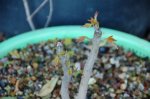


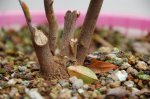
Most of these were taken down to just a couple inches in January after the fall. They were about 6 feet tall. The trunks average about 3/8 inch and this is the start of their third year. These are the saplings from the seeds under screen project. All of these were planted into colanders and thru holes drilled into plates. This is the secod year thru the plates.
Many times when reading about projects on the net about developing trunks we read about planting in a suitable pot or the ground and let grow unchecked. For the most part this is true. the tree will take off and grow unhindered and the trunk will swell. What you don't read is how to continue to deal with the trunk each year.
For this continued process it is my desire to build large based tridents with large buttressing bases for shohin. I am not building a large tree of kifu or chuin size but small tree less than eight inches tall. I do have some of the projects that are being grown for larger trees and they are being grown in the same way though will take longer.
When a trident grows each subsequent branch that grows from the trunk will add girth to the area below it for a small portion of that area below it. For instance to grow a large first branch on a maple or any D tree, the idea is not to grow a branch unhindered for several feet in length, the fast and better option is to grow it in segments with diminishing taper in the same way one would grow a trunk. Growing a branch long will of course make the branch larger but the longer it gets the more diminishing effect it has on the branch. By the time it grows six or eight inches from the trunk it is really adding nothing to the girth at the base of the branch which is where we desire the growth.
To grow a branch at the intersection of the trunk and branch one would do better by using a first shoot from the branch closest to the trunk and allowing that shoot to elongate. This will add girth to the area below it, which would be the joint from trunk to first bud, which is the part we wish to increase.
It works the same way on a trunk. To increase girth (diameter) of the trunk, we have to focus all the energy into building that area larger first. That can be acomplished in the ground but we also get coarse branches, large roots and a base so large that it will never fit the correct size pot. This is why growing in colanders is important. After trunk building in either a grow pot , nursery container or suitable, a season or two in a colander will manage the root pad down to a size suitable for the correct pot.
My trees were grown to about 3/8 size and this year they were all chopped to help grow the base faster to fill the holes, make the roots and build a base. To do this we need the plant to focus all the energy into the base. This is best done by making the base only a couple inches tall. When the plant pops for the spring, the entire opening growth spurt will be focused into the base of the tree. I can expect a doubling of size while it does this. There are no branches to rob energy away from the tree and the tree will push hard to build a canopy for the manufacture of food. This need for survival is how I get the focused energy where I want it. In subsequent years I can work on branching and the like, but for now I need the base and roots and that is the first thing to work on.
Last edited:


