cytokinin powder test

Hi there, still looking how are going the plants with the cytokinin test.

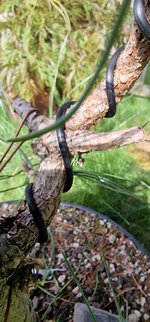
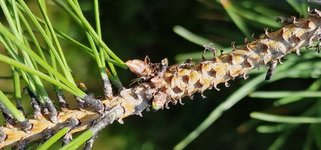
Here are some pictures, the thing that is unusual for me is the number of the new buds on the mugo, on the clean part very near to the soil, also the ABP has some extra backbuds

Mugo

20230908_131045.jpg20230908_131150.jpg20230908_131153.jpg20230908_131158.jpg20230908_131211.jpg

ABP

20230908_131114.jpg20230908_131124.jpg
 
Hmm I don't see any results that make me think that it's the powder.

My mugo buds as much on young wood when it's exposed to sunlight.
My other pines make about the same amount of buds on the nodes in their first couple years.

Can you try it on older wood? Maybe 5-6 years old?
If that works, then I'm convinced.
 
Ok, just an update.
We know that Cytokinins promotes cell division, in other words, growth. Where auxins will inhibit lateral buds, cytokinins will promote growth all over the tree. In the absence of auxins, cytokinins will cause lateral buds and dormant buds to grow.
Pruning, candle removing and pinching of new growth will all aid in reducing auxin levels and promoting more lateral growth.
This year I have used again the Cytokinine, but this time after cut the new grows, I have had some deep backbudding, of course I am not sure that is the product or not, burt one bud come from the last year and it was basically at the base of the trunk itself, one bud was open on a branch that I cut in april, and there was nothing before I am sure 100%.
Thtat's on the ABP:

Last year, bud open this spring, last year I have used more often theproduct.

20240821_164348.jpg20240821_164343.jpg

On an April cut :

20240821_165330.jpg

Some more bockbuddings:
20240821_164415.jpg20240821_164421.jpg

The Mugo have some strange ? grows, but I made also a good pruning in July Vance Wood style, so maybe is not related...

20240821_165614.jpg

Let me know what you think, now is the second year that I used this product and the plant are still alive, I also used on other plants with no problems.
I used also last year on my Scott Pine and I am starting to think that the several buds explosion was from the Cito powder...


20240408_180915.jpg
 
Back in the middle 80's when I was a grower at a large commercial nursery we grew tens of thousands of Christmas trees in pots. They were pines, though it was not my department so I don't recall the species.

They sprayed 6-BA several times during the young growing season. The lateral branching was unbelievable. They did side by side comparisons to dial in the rate.

I recently bought some 6-BA and will do some trials with some JBP if I can get enough to make a decent experiment.
I think 30 would be a decent trial (control and 2 rates).

Have you any suggestions, I have seen Musser seedlings
Other recommendations?

Rates for bedding and perennials is pretty low 100-600ppm.

Here are a couple links
https://journals.ashs.org/hortsci/view/journals/hortsci/11/1/article-p43.xml?tab_body=pdf. Holly branching
 
I recently bought some 6-BA and will do some trials with some JBP if I can get enough to make a decent experiment.
I think 30 would be a decent trial (control and 2 rates).
Did you started the test ?
I have all but still try to decide the righe moment when give the hormon, before the pinching in April, before the decandeling in July or in the middle, or both.
Any ideas ?
 

Treatment in Scots pine: I guess a caveat is the foliar distortion, and genetic susceptibility varies between seed grown plants. It might be the case that the Xmas tree farm used a homogeneous strain: I know that is the case for wood farms, at least.
 
This was an interesting read and the photos show good results but it’s hard to say with any certainty at all that there is a benefit if there is no control in the experiment. Ideally two plants in as close to identical states would be needed, one for the experiment and one for control.
 
Did you started the test ?
I have all but still try to decide the righe moment when give the hormon, before the pinching in April, before the decandeling in July or in the middle, or both.
Any ideas ?
I have not started. I had trouble finding commercial sources of JBP that would ship to CA. So I bought some seed......
 
I have not started. I had trouble finding commercial sources of JBP that would ship to CA. So I bought some seed......
 
Thanks but they are way too expensive for a decent trial.
 
So I grab some real 6BA-BPA hormon, just need an idea about the best moment to use it:

1 when the plant start to move so now
2 after the strength balance with candle pinch in about one month
3 after decandeling in july

Any Suggestion ?
 
When watering, I wet the whole plant, so that includes a foliar application. I didn't really think about treating just the roots as an option. That said, I guess you could use a sprayer to wet just one branch and see if it's any different than the other branches on the same tree. However, I would do that with separate trees in a separate test.

🤔 I'm sure you'd probably get some growth to be sure but given the objective would be reaching the cambium where the epicormic buds dwell I'd anticipate root treatment would be far more effective then foliar treatment... Especially since you'd be providing the hormone in its place of origin (root tips) although my thinking here could certainly be far from the base... Maybe I should run a test on some bald cypress if they survive the winter after all we do apply auxin directly to the cuts to produce rooting instead of at the tips of the branches 🤔

So I grab some real 6BA-BPA hormon, just need an idea about the best moment to use it:

1 when the plant start to move so now
2 after the strength balance with candle pinch in about one month
3 after decandeling in july

Any Suggestion ?
Excited to see your results although I do wonder if nonwhorl based evergreens may produce better results? I know whorl evergreens like pine and spruce tend to have less epicormic shoots and have much higher levels of auxin (college maybe failing me here but my horticulture class says that auxins and cytokinin balance out based on the trees genetics resulting in different shapes and chemical application can be used to alter the phenotype temporarily) where evergreens like yew produce buds "randomly"

I would anticipate cytokinin treatment to be most effective on deciduous trees if my reason applies appropriately although I can't think of too many deciduous we struggle to reduce... Maybe beech? I haven't worked with the species but I know @leatherback trims the buds within the sepal if I recall a video correctly... Can't imagine you'd need to do that with a normal deciduous tree 😅
 
Back in the day (1980's) large commercial production of pines for potted Christmas trees applied 6-BA as a foliar spray. We also used foliar sprays to produce short well branched 4" flowering crops.
6-BA does not translocate very well so applications need to be on the stems. Additionally the plant should be in active growth.

Several commercial products are available if you have a PCA license and $$$. Some also contain gibberellins which will also trigger internodal elongation.
Or you can buy some as a powder form online.

For pines:
Each set of needles is actually a modified short shoot coming from a lateral bud. Most lateral buds are produced at the apical meristem during normal stem development (there are true epicormic buds for sure, just look at the trunks of P. canariensis). The "scales" on the stem are non-photosynthetic leaves with a lateral bud just above it. The key is triggering that lateral bud to grow resulting in "back budding).

I am growing some trees from seed to try out the application but I am still likely a year of 2 away.

If someone wants to send me 30 2yr old JBP as a trial I will be happy to send them back afterwards.
 
Back
Top Bottom