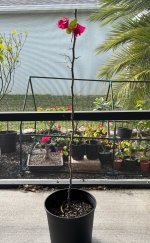
After a lot of thought more or less because this thread "maybe" was a response to one of my own.
Thoughts.
Bunjin / Literati Bonsai: An Art-Forward Defense
Bunjin, or literati bonsai, occupies a unique and often misunderstood place within the bonsai world. Its sparse lines, elongated trunks, and minimal foliage frequently invite questions: is it “finished”? Does it follow conventional rules? Is it correct? From a traditional craft perspective, these questions make sense—but they miss the deeper significance of bunjin as a
form of living sculpture and expressive practice.
Seen through an art-forward lens, bunjin is not a compromise or a shortcut. It is a medium for
poetic narrative and formal exploration. Each bend, each carefully pruned branch, becomes a gesture. The negative space around the tree is as significant as the living material itself. Every reduction—the absence of foliage, the tension of an exposed branch—is deliberate, intentional, and expressive.
1. Minimalism as Expression
In conventional bonsai, fullness and balance often dominate visual priorities. In bunjin, the eye is drawn to
line, proportion, and movement. Minimalism allows the tree to speak in a visual language akin to drawing or sculpture:
- A single winding trunk evokes struggle against wind, gravity, or adversity.
- The placement of each branch creates rhythm and tension, akin to a musical composition.
- Empty space—the areas intentionally left untouched—carries meaning as much as foliage or wire.
Here, craft and art intersect: horticultural knowledge ensures the tree survives under minimal conditions, but the design decisions transform it into an expressive object.
2. Narrative and Metaphor
Bunjin functions as a narrative device. Its leaning, contorted trunks suggest movement, endurance, and resilience. Trees tell stories of adversity, solitude, and elegance in imperfection. From an art perspective, the tree is more than a living plant—it is an evolving sculpture, a temporal artwork whose changing form carries both the maker’s hand and the lived experience of the tree itself.
3. Authorship and Intention
Critics sometimes dismiss bunjin as “random” or “neglectful,” but the apparent simplicity is deceptive. Every pruning cut, every wire placement, every decision to leave or remove a branch is an act of
authorial presence. Bunjin demonstrates that art and craft are inseparable: the practitioner’s choices are visible, intentional, and accountable to both the tree and the design.
4. Craft as Foundation for Expression
Bunjin cannot exist without
deep craft knowledge. Understanding water, light, species-specific stress tolerance, and pruning consequences is essential. Art cannot survive without craft: expressive freedom in bunjin is contingent on mastery of the material. Craft is not a limitation; it is the medium that enables the expressive potential of the tree.
5. Perceived Rules and the Illusion of Freedom
Bunjin is often described as “freeform,” but this is misleading. Its power comes from the
manipulation of perceived rules.
There are clear principles: graceful trunk movement, taper, branch flow, and proportional tension. Yet these are
guidelines rather than prescriptions. Sparse or improbably angled branches may appear to break rules—but these apparent deviations are deliberate, grounded in both craft knowledge and aesthetic judgment.
The practitioner’s skill lies in
balancing perception and reality: to the viewer, the tree seems spontaneous, organic, or even contrarian; behind the appearance is decades of practice, careful pruning, and subtle management of growth. Rules in bunjin function as a
language of expectation, and departures from that language become expressive precisely because the maker understands the craft deeply enough to choose when and how to bend them.
6. Bunjin as Contemporary Art Practice
Bunjin can be appreciated as living contemporary art:
- It is temporal, evolving across seasons and years.
- It is interactive, engaging the viewer with line, space, and implied motion.
- It is conceptual, conveying narrative and metaphor through form and restraint.
- It is durational, integrating both the maker’s intervention and ongoing care into the work.
From this perspective, bunjin is not a subset of bonsai—it is a
discipline of sculpture, narrative, and time-based practice.
7. Conclusion: Mastery, Restraint, and Art
Bunjin demonstrates that
art and craft are not opposed—they are complementary. Craft ensures survival, structure, and longevity. Art frames those decisions into expression, narrative, and gesture.
Its power lies not in density, ornamentation, or ostentation, but in
restraint, intention, and visible judgment. Its authority comes from mastery: the practitioner knows how far the tree can be reduced, how to balance tension, and how to allow minimal elements to carry maximal expression.
Bunjin does not need art discourse to defend it, nor should it be romanticized as pure freedom. It is a
proving ground for craft and art simultaneously: disciplined, expressive, and eloquent in its silence.