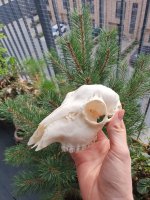
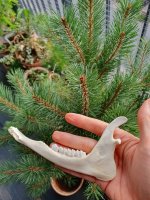
Collecting P. sylvestris from the mòine àrdaich.

Bog pine #1 has some kind of adelgid infestation. Sprayed with provanto smart bug killer. Will respray in a week.
 
Good to know @TomB
How were they transplanted and what sort of substrate have you used?
 
Just a little post to keep my bogland activities up to date. No pines this time, sorry.

In June I spent a week doing conservation work on the west coast, one of the days was birch pulling in a raised bog.
Other species we removed were Picea sitchensis and Rhododendron ponticum.

Sharing some of my finds.

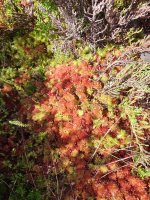
My first time seeing Drocera (rotundiflora... I believe) one of three species of carnivorous plants in the UK.
It would be quite interesting to try and cultivate drocera, possibly in the water which I grow my taxodium distichum.

View attachment 611068

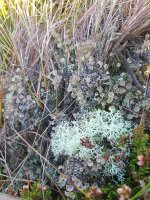
View attachment 611069

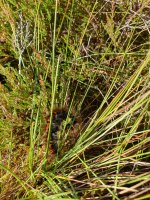
This little frog guy
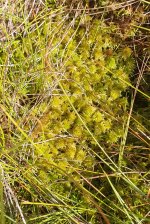
View attachment 611070


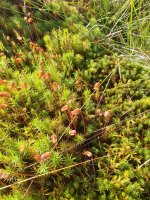
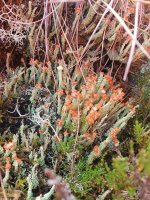
Some quite dehydrated Polytrichum strictum (bog haircap moss) native to sphagnum bogs. I find the colours and forms of bog mosses fascinating, but ive much to learn.
View attachment 611073


This little lizard guy hanging out on the boardwalk as we had lunch.
View attachment 611074


I took more photos on my 35mm which I've yet to develop.

There were also quite a few dragonflies, damsen flies etc, but very hard to photograph.

Thanks.
E.L.L
I have cultivated drosera for years, sphagnum peat moss and rain water are the best. They don't need anything else. Locally I found them growing in sand too, as long as it's soaking wet every winter and spring.
Some are in the pond basket in the water. Others I kept in black peat with a layer of sphagnum on top.

Sometimes they have a little mutation and grow heart shaped leaves, those are the best. But they never do that for a long time. You can multiply them pretty rapidly by taking one of those hairy leaves and put them in boiled and cooled sugar water (10 grams / L).
Cover it with foil and put it in a light location. Change the water every couple of days. In about three to four weeks, they should send out little clones from the center of the leaf. Usually one per leaf, but I have seen more.
Watch out though, the drosera family is wild and comes in a variety of forms and shapes, you might get hooked and leave the forum for more carnivorous pastures.
But cool as drosera are, nothing beats byblis. I hope to own a couple in the future.
 
Good to know @TomB
How were they transplanted and what sort of substrate have you used?
Nothing special, get as much root as possible and so on.
Substrates I've tried have ranged from the native soil they were growing in, to acidic substrates such as kanuma/akadama mixes. The plants have always weakened and died over a period of months.
If you do it successfully, be sure to share the details!
 
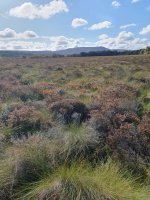
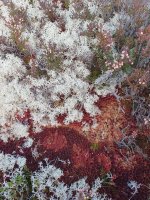
The bog was quite dry and covered in Heather (unsure on species, something i will learn to ID for future posts.)
We have similar landscapes like that. Mostly covered with Calluna vulgaris and sometimes some Erica species.
We use sheep, they eat all the seedlings of the birch and other trees. The sheep are taken back to their stables each afternoon so when they poop it doesnt fertileze the soil, keeping the soil arrid and low in nutrients. When the heather blooms the smell and beauty it just something magical you cant describe.
 
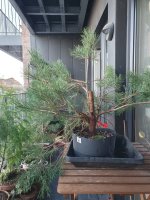
Bog pine #3

Was out on the bog today.
Just got home and stuck this in a pot quick.
Will post more detailed updates about my day and hopefully better photos of the pine soon. I need to eat and bathe first.

20250928_183336.jpg
20250928_183320.jpg

20250928_183311.jpg


It's a weird thing. Takes up half my balcony
 
So yesterday,
Bog I've not visited before. Though I have hiked past it a couple years ago.
It's a very well maintained raised bog, though due to our weather this year it was fairly dry underfoot.

We pretty much spread out in a line, and walked the breadth of the bog, pulling saplings as we go. Not unlike how a police body search is shown in TV programs. The saplings were few and far between, and rarely were tools needed to cut them from the sphagnum. Mostly just pulled out.
The saplings were denser around the perimeter as expected, predominantly Betula pendula, and rarely Pinus sylvestris, Picea sitchensis and Larix × eurolepis.
Its great to see a bog in good condition as this, but because there was so little work to do it felt like we hadn't done much! The hardest work was simply walking in a straight line across the bog. Often having to straddle over tussocks, minding where one steps. My ankles and calfs are sore today.

20250928_134040.jpg
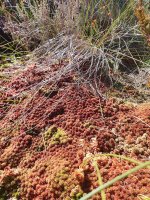
Heathers, tussocks, and I believe the lighter orange/red to be Vaccinium oxycoccos (wild cranberries)

20250928_104824.jpg
Sphagnum subnitens.

20250928_105400.jpg
Cladonia chlorophaea top and Cladonia portentosa below.

20250928_110605.jpg
Sphagnum fallax.

20250928_111726.jpg
Polytrichum commune, with reproductive capsules.

20250928_113111.jpg
Sphagnum capillifolium.

20250928_115124.jpg
Macrothylacia rubi (fox moth catapiller)

20250928_121529.jpg
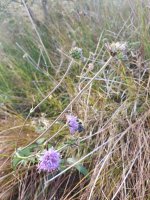
Knautia arvensis
(common scabious) being visited by a bee.

20250928_142311.jpg
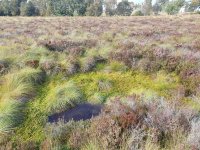
A healthy pool.

20250928_144656.jpg
Cladonia floerkeana. Showing red/orange apothecia.

20250928_144855.jpg
My favorite photo of the day, Cladonia portentosa and sphagnum capillifolium.

I also saw frogs, snipe and a pheasant. A fun day!

Until next time...
Cheers.
E.L.L
 

Attachments

  • 20250928_144855.jpg
    20250928_144855.jpg
    491.3 KB · Views: 18
BOG PINE #4

Out west on a weekend residential, been in a bog today, pulling birch, scots pine, sitka, rhododendron, some hemlock, rowan.
We've had rain over the past week so it's the wettest bog I've visited all year.

Found a scots pine.
IMG-20251011-WA0005.jpg

20251011_154302.jpg

Seem to have managed to keep a decent amount of roots.

I we have another day of other work ahead of us, so this will be wrapped up and kept outside until our journey home.

20251011_103836.jpg
Dead scots pines in the center of the bog, there's an artificial osprey nest which is occupied amongst the trees, though not pictured.
Took some photos on film too.


Maybe I'll make an update when I'm home and it's potted up.
Until next time.

E.L.L
 
BOG PINE #4

Just finished potting up this morning. Loads of fine feeder roots among the sphagnum and peat field soil.

feel like I've managed to keep a good root ball. Hopefully it will do OK.
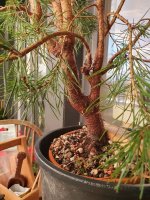
Maybe the closest to a typical bonsai shape I've found so far.

20251013_093612.jpg


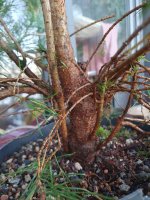
Detail of branching and bark 20251013_093931.jpg

Cool little thing.

Cheers.

E.L.L
 
BOG PINE #1

This morning I've wanted to have a good look at this tree. I've suspected that at some point I'll be removing some of the uprights and reducing it in height somewhat, hopefully promoting back budding.
Lifting it out of its spot I was quite suprised to see roots growing out the holes in the much larger container pot I had to wire it into to stop it from falling over in the wind!

20251110_080955.jpg20251110_080645.jpg
I never expected it to fill and escape both pots it's growing in less than a year since collecting.

20251110_080747.jpg
I snipped the wire I used to first wire it into the teracota pot as it seems to be very firm, and just starting to cut into what will become the nebari.

A little while ago I mentioned that it had became quite infested with pine bark adelgids. I sprayed with provanto as per instruction, which seems to have decimated the population. Though it is something I will continue to keep on top of.

Somewhat unsure now on the next step. Although the root growth is fantastic. I feel I now need to get it into a better container set up. Or use the strength of the vigorous root growth to power back budding.

Something to think about.
 
A general update too... Next week will be the last bog of this year, one where there is few only P. sylvestris past a couple years old, so I suspect I won't return with any material, but I will be on the lookout for material to potentially use for the 5 year raft competition regardless.

Also I've been given a line to get permission to collect pines independently from one of the bogs not far from where I live. So that will definitely be in order next spring.

Cheers,
Until next time
Erika
 
Last bog of the year, though I think we will return in February.

Mainly birch and sitka again, scots pine were few, I did dig out two for consideration, but they had very sparse foliage. And decided its not worth the hassle.
20251116_145152.jpg
 
First bog of the year, I've missed the dank smell of the peat and sphagnum.

20260124_115605.jpg
20260124_120225.jpg

2025 was very dry all year, 2026... we've had rainfall most days, so it was interesting actually being in a wet bog.

I explored an area deeper into the bog, which we haven't touched in quite some time. A good fair few scots pines were obvious as the birch had dropped all their leaves.

I reduced the branches and canopies of a few pines which were too large to collect today, left them in the ground in hopes of reducing the size and encourage backbudding, to allow me to get them in the van and back home. I'll come back and collect them at some point, unless they are removed by someone else.

I did end up bringing two home with me though.

BOGPINE #5
20260124_185042.jpg

BOG PINE #6

20260124_184916.jpg


I didn't manage to collect as much rootball as I would have liked on both of these. It's interesting that I found collecting trees when the bog was dry much easier- locate the root ball and cut around it with a silky. Pull it up and out comes a big square chunk of peat intact.
When the bog is wet the peat and sphagnum easily detaches from the roots, breaking the finer feeder roots. I did pack the spagnum back around the roots for transport home.

I believe these both were producing cones which is exciting.

Also hey what a difference having a backdrop does to the photos!
I'll have to make an update on last year's collections.

Cheers.
Erika
 
Nothing special, get as much root as possible and so on.
Substrates I've tried have ranged from the native soil they were growing in, to acidic substrates such as kanuma/akadama mixes. The plants have always weakened and died over a period of months.
If you do it successfully, be sure to share the details!
Have you tried only using distilled or purified water. I was advised tap H2O may have killed my Sarricenia so now only use purified H2O.☺️
 
Have you tried only using distilled or purified water. I was advised tap H2O may have killed my Sarricenia so now only use purified H2O.☺️
No, though they mainly got rain water. I am guessing there is a mycorrhizal fungal association going on with the soil environment which I messed up when I collected them.
 
BOG PINE #6
Some notes and observations.
20260124_184916.jpg

• When I found this it was partially buried under debris from a previously felled birch.
From the photo above you can see a stem to the left, which I have cut. This was much longer, trailing along the bog, and grew very sparse foliage.

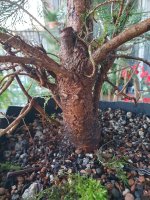
• The lower trunks of the pines I've collected thus far have all been somewhat excavated from sphagnum. When initially germinated they established their roots, over time, the surface layer bog has risen with layers and layers of decomposing spagnum.
I read somewhere on this forum, in a thread about collecting Larix from a bog. That the rise of the surface layer causes ground layering, and roots establishing themselves up the trunk. I've not found this true for Pinus sylvestris.

Another note regarding the trunks, and raising surface level, the trunks are somewhat buried and damp most of the season. I believe this to inhibit bark maturation on submerged portions.
20260126_111715.jpg

Where as in the branching it displays nice textured bark, although, this may be enhanced due to grazing damage and/or damage due to growing through the birch debris I mentioned.

20260126_105503.jpg
[Edit to add: I'll be interested to see how long it takes for the lower bark to catch up]


• I found a cone on this pine. Though it looks like it was damaged and won't reach maturity. But it will be the first of my pines which produce cones.

20260126_105455.jpg
 
BOG PINE #5
Lower and upper bark comparisons to continue my post above:

20260126_105645.jpg
You can almost tell how deep this had been engulfed, after the first branch the bark starts to look more mature.

20260126_084834.jpg
 
Back
Top Bottom