Tall skinny Acer Buergerianium

Cockerhoop

Seed
Messages
3
Reaction score
0
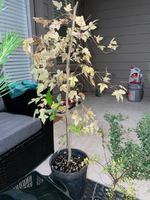
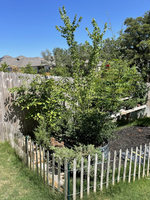
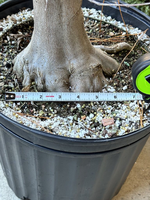
I have been given a 5ft Acer Buergerianium in a not very large pot, the base of the stem is only about a centimetre thick. I realise this is going to be a long job, but that’s okay.
I have just put it in a large pot with free draining compost, to grow it on to a healthier state (it’s long and whippy), and I’m tempted to cut most of the stem away, but that would leave no branches, is that okay? Obviously I want the stem to thicken up first as much as possible and for the tree to become sturdy.
 
Do not cut anything. If you keep it in a pot, make it a wide shallow one and ensure you spread the roots out radially, horizontally. Then just let it grow to another 5ft, get the base to fatten up..
 
Do not cut anything. If you keep it in a pot, make it a wide shallow one and ensure you spread the roots out radially, horizontally. Then just let it grow to another 5ft, get the base to fatten up..
Thank you, glad I waited! I just replanted it straight into the largest pot I could find (no room in open ground). I didn’t splay the roots, would it be best if I take it out, splay roots and replant? I’m a bit worried about the wind destabilising it and carefully staked it with canes, this would be a bigger risk in a shallower pot I think?
 
I'll offer a contrary view just to make the decision harder.
I grow a lot if tridents in ground and find I get far better results with regular pruning and root pruning.
Regular root pruning does not slow growth as much as some would have it but does promote far better nebari and finer roots so the trees transplant much easier. Any reduction in growth is negated by better nebari and ease of transplant.
Pruning the top may also slow growth but seems only fractional slowing. Regular pruning gives me bends in the trunk and taper in the trunk. Both are worth any reduction in thickening.
Regular (annual) pruning also gives me much smaller scars to heal and earlier scars are healed by subsequent growth. This saves many years in the final development phase. I'm confident I can produce better trunks in the same or less time with regular chops than the grow to full size and one massive chop.
I didn’t splay the roots, would it be best if I take it out, splay roots and replant?
Root work is definitely advised. Nebari is a big factor on good deciduous bonsai and good nebari starts early. No problem repotting after just a few days.

BTW, bonsai techniques vary according to location and climate. Best to add a location to your profile so we can give better advice
 
Regular (annual) pruning
What sort of growth you can get in a year? It might be climate dependent a little..?
For me, tridents do well if they push 5ft+ in a season, resulting in a small diameter. Leaving it for another seasons can triple the diameter, and it is worth leaving a sacrifice on longer? I have one in full ground now for ~8 years, which with pruning every 2 years has a 4 inch / 10cm base.
 
I'll offer a contrary view just to make the decision harder.
I grow a lot if tridents in ground and find I get far better results with regular pruning and root pruning.
Regular root pruning does not slow growth as much as some would have it but does promote far better nebari and finer roots so the trees transplant much easier. Any reduction in growth is negated by better nebari and ease of transplant.
Pruning the top may also slow growth but seems only fractional slowing. Regular pruning gives me bends in the trunk and taper in the trunk. Both are worth any reduction in thickening.
Regular (annual) pruning also gives me much smaller scars to heal and earlier scars are healed by subsequent growth. This saves many years in the final development phase. I'm confident I can produce better trunks in the same or less time with regular chops than the grow to full size and one massive chop.

Root work is definitely advised. Nebari is a big factor on good deciduous bonsai and good nebari starts early. No problem repotting after just a few days.

BTW, bonsai techniques vary according to location and climate. Best to add a location to your profile so we can give better advice
Ok, thanks, I’m actually in Wales in the UK. On consideration I think I may be able to spare a small patch of ground for a year or two, and now thinking it might be best to try to splay the roots over a quarry tile to encourage lateral growth. I think I’m going to leave the pruning, as there really isn’t much to prune, beyond a few small branches at the top anyway, for now. It’s interesting that there are different approaches, strangely it makes me feel a bit more confident about it all!
 
What sort of growth you can get in a year? It might be climate dependent a little..?
Smaller Trident seedlings can get up to 1.5m in a season. Older tridents with established roots grow from 15 or 20 cm tall to 2m or more even if the roots are chopped back hard.
Good point that climate is going to have an influence on total growth so chopping every 2 years may be better in some places. That's mostly how I treat Japanese maples and Chinese elms which grow a bit slower but that still amounts to grow and chop and grow and chop, just spacing the cycles a bit further apart.
What I'm trying to get people to see is that the grow to full thickness then make a big chop is not the fastest or best way to develop trunks.
Apologies if I misunderstood your intent.

It’s interesting that there are different approaches, strangely it makes me feel a bit more confident about it all!
You'll no doubt find more differences of opinion as you go on. Most newbies find it quite frustrating that there's no one 'right' answer. Your attitude is refreshing that you can see if there's many slightly different approaches that work it is not so critical to find the one correct method. Allows you to try different approaches, learn as you go and, hopefully, find techniques and approaches that work under your conditions and your care regimes.
 
What sort of growth you can get in a year? It might be climate dependent a little..?
For me, tridents do well if they push 5ft+ in a season, resulting in a small diameter. Leaving it for another seasons can triple the diameter, and it is worth leaving a sacrifice on longer? I have one in full ground now for ~8 years, which with pruning every 2 years has a 4 inch / 10cm base.
I get decent growth out of them, but like you said I think it is weather dependent. Here is the only trident I have that is not a seedling at this moment, this is a 3 year progression from a 1 gal nursery tree I bought from Brent. I use a RootPouch to contain the roots closer to the tree, this one did have a few roots escape, but not as many as other trees I have. Its been 3 years in that bag and will be re-bagged this spring as soon as the buds start to break.

Nov 2020
1707223277257.png

Jun 2021
1707223321308.png

Jun 2022
1707223380476.png

1707223422888.png

Aug 2022
1707223474075.png

Jan 2024
1707223550042.png
 
What you have in 3 years takes me a decade here..
I know, the weather there is not great for a lot of species. I would recommend you try the RootPouch bag, if they are available there, they do speed up the growth as well. I have seen a few tridents growing on the ground here, and their development is not even 1/2 of what I am achieving. I am not familiar with the nutrition schedule the growers are using, so that may have something to do as well.
 
I am not familiar with the nutrition schedule the growers are using, so that may have something to do as well.
Suspect you are correct. It is possible to provide the best conditions in pots where trees in the ground just get whatever the ground supplies - nutrients, water, etc.
I've noticed reduced growth rates over the past few years in my grow beds so suspect that something is now limiting growth but hard to tell whether that's water, nutrient, trace elements or pest and disease build up.
Conversely, without meticulous attention to fert and water pots can also limit growth. On the whole, local soil will usually even out moisture and nutrient swings and probably give better growth for most growers than pots will.
 
Suspect you are correct. It is possible to provide the best conditions in pots where trees in the ground just get whatever the ground supplies - nutrients, water, etc.
I've noticed reduced growth rates over the past few years in my grow beds so suspect that something is now limiting growth but hard to tell whether that's water, nutrient, trace elements or pest and disease build up.
Conversely, without meticulous attention to fert and water pots can also limit growth. On the whole, local soil will usually even out moisture and nutrient swings and probably give better growth for most growers than pots will.
This might be a reason to use pots sitting on the ground, with sufficient holes to allow escape roots to run wild, moving seasonally to not let them over-dominate.
I think I might try this
 
Smaller Trident seedlings can get up to 1.5m in a season. Older tridents with established roots grow from 15 or 20 cm tall to 2m or more even if the roots are chopped back hard.
Good point that climate is going to have an influence on total growth so chopping every 2 years may be better in some places. That's mostly how I treat Japanese maples and Chinese elms which grow a bit slower but that still amounts to grow and chop and grow and chop, just spacing the cycles a bit further apart.
What I'm trying to get people to see is that the grow to full thickness then make a big chop is not the fastest or best way to develop trunks.
Apologies if I misunderstood your intent.


You'll no doubt find more differences of opinion as you go on. Most newbies find it quite frustrating that there's no one 'right' answer. Your attitude is refreshing that you can see if there's many slightly different approaches that work it is not so critical to find the one correct method. Allows you to try different approaches, learn as you go and, hopefully, find techniques and approaches that work under your conditions and your care regimes.
Personally i would say climate plus the care you can provide both play a role. It does help to basically have summer for 10 months a year ;) @leatherback. My climate also seem to encourage a lot of growth as the previous years getting 5 to 9 feet was not unusual. But last season we had a especially hot spring and summer, with 34C to 37C temperatures and not able to provide the same care or at least the care these temperature required, the growth has been about half.

Ps @Shibui, i've been meaning to try this approach of yours considering that my climate sounds like it is similar to yours, hopefully i just remember to plant control trees and take pictures 🤣 as this will be a 3 to 5 year endeavor
 
Suspect you are correct. It is possible to provide the best conditions in pots where trees in the ground just get whatever the ground supplies - nutrients, water, etc.
I've noticed reduced growth rates over the past few years in my grow beds so suspect that something is now limiting growth but hard to tell whether that's water, nutrient, trace elements or pest and disease build up.
Conversely, without meticulous attention to fert and water pots can also limit growth. On the whole, local soil will usually even out moisture and nutrient swings and probably give better growth for most growers than pots will.
A few years ago I had no freaking clue about growing anything, I was in Germany and I noticed that the field they used for wheat next to the post was tilled and new compost was added every time it was harvested. So this may be the reason why. Also, this is the reason I use RootPouch, because I can control the nutrients going into the tree in a small zone, which consequently is full of feeder roots thanks to the entrapment pruning. I think this definitely give me an advantage.

I can't take credit for doing it this way, as I kinda emulated what @cmeg1 does in his ebb bed. He was the one that introduce me to the RootPouch, as he used the small black ones in his early days. Now he use rockwool, which I will be experimenting with in the future.

This might be a reason to use pots sitting on the ground, with sufficient holes to allow escape roots to run wild, moving seasonally to not let them over-dominate.
I think I might try this
Yes, I know a lot of people do this but I first saw it from Peter Chan. I think it is a good method, when you can't have an above ground bed, but I think that the pouch is a better method as it encourages the creation to feeder roots near the trunk. Which will, I think, allow the tree to recover faster comes time to put it on a bonsai pot.
 
Back
Top Bottom