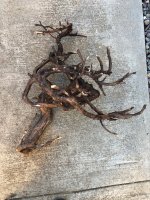
Removing Bark for a Tanuki Project

Esolin

Shohin
Messages
484
Reaction score
766
Location
So Cal
USDA Zone
10b
I dug a massive procumbens juniper the other day and ended up lopping off a horizontal branch/second trunk. It's got some amazing character and I'm tempted to try to make a tanuki out of it (never made one before). But cleaning the bark off... am I out of my mind? Should I wire brush? Sand blast? Just clean the exterior jins and let the bark on the inner twists rot off in time? Toss this pretzel in the trash as a fool's errand?

tanuki1.jpg
 
Sit down and take your time. Looking pretty is hard work.
Sometimes a soak for a few days helps. Or take the rough stuff off, and let it sit in the weather for a bit.
 
If this piece is cut very recently I think you can peel off the bark relatively easy.
If you wait a few weeks it will become much harder to get the bark off (junipers).
 
Thank you, both. It seemed like it didn't want to peel, but with the right tool ( a dull chisel) it's coming off slowly. An hour of chipping was all my hand could take without cramping. I wet it down and wrapped it in a plastic bag to keep it soft until I can work on it again next weekend.
 
Live bark comes off easily in the growing season when cambium is active but when the tree is dormant the bark is much harder to remove.
When the branch dies bark becomes very hard to remove. Not sure how long it is between live and easy and dead and difficult but a few days is certainly enough to make the bark stick. After that it's a matter of chipping a little bit at a time or take to it with a rotary tool.
The other option is to let it weather for a few years. Eventually the bark breaks down and peels off relatively easily.

You haven't given us any scale in the photo. Is the branch thick enough to make a decent phoenix graft? Seems pointless going to all that trouble sticking a live vein on an inch thick dead wood. I'd also be interested to see how well you can get a new live trunk to follow all those bends. Lots of bends is definitely desirable but might make the process a lot more challenging so good luck with the project.
 
There is a tendency to use juniper graft to a tanuki. But junipers really don't fuse well. Their bark does not readily roll over the grafted wood. But if you secure the scions well, they do make nice Tanuki.

Maybe use a shorter needled pine, like Pinus leiophylla, since you like sourcing unusual botanical material. Pinus radiata might work, but its rapid growth rate might get away from you, needles can be as short as 3" but they can get to 6". JBP could work.

Tanuki made with broadleaf trees have been done. There was a Tanuki Ficus shown at a show in Chicago 3 decades ago that fooled the show judges, they almost gave it best in show until they found out it was a Tanuki.

So if you have a species you like working with more than juniper, feel free to try it for tanuki. Though Juniper is the "proven, tried and true" more likely to be successful route to a Tanuki.

 
You haven't given us any scale in the photo. Is the branch thick enough to make a decent phoenix graft? Seems pointless going to all that trouble sticking a live vein on an inch thick dead wood. I'd also be interested to see how well you can get a new live trunk to follow all those bends.
I'll take a scale-referenced picture this weekend. The main trunk is about 2.5 inches in diameter (5-6 cm). Yes, following most of the twists would be difficult to impossible. I'd probably run the graft up the gentle P-shaped curve on the back, and then have 2 or 3 live branches peek over or between the nexus of deadwood twists.

I suggest using 'Kishu' cultivar of shimpaku juniper, it has the nicest foliage traits in my opinion. Evergreen Gardenworks usually has them in stock.
I bought some Kishu and Itoigawa cuttings from Bonsaify and have been getting a feel for how they grow here. I do love Kishu foliage, and it's density would work well for backdropping the deadwood. But I have noticed some tip dieback on my Kishus the past few winters, which is odd because it doesn't get that cold here. Although it does still bronze a little. I'm a bit puzzled this is a common trait, or if I'm doing something wrong. They do need to be repotted (bad percolation). Maybe it's a root issue.

A pine tanuki could be really awesome, but I think anyone who's practiced bonsai for more than 5 minutes would raise an eyebrow at a pine with such crazy looping deadwood. It would be obvious it wasn't a natural pairing and possibly distract from enjoyment of the piece.
 
Okay, I managed to scrape off as much of the bark as I could. Unscraped areas were already dry deadwood and will require a lot more effort. I'm going to let it dry out, then use a wire wheel and sanding bur to remove the residual 'fuzz'. There is some punky/termite hollowed wood. I assume this must all be removed to preserve the remaining wood.

tanuki1.jpgtanuki2.jpgtanuki3.jpg
 
Looks much better cleaned and even better with something for scale.

Punky wood is more likely fungal infection - rot. Looks like that section has been dead for some time, giving natural wood decay organisms the chance to start doing their job.
You will need to apply some wood preservative to maintain the dead wood. That should also stop the existing rot progressing further.
Soft wood can be hardened using wood hardener or removed. Scraping rotted sections out often improves the aged look of dead wood so I would go ahead and carve out as much as I could before applying wood preservative.
 
Back
Top Bottom