

Jetson1950
Shohin
This will be my first attempt at making a forest bonsai. Still being a newbie and not even up to the rank of bonsai amateur yet, I’m probably making as many mistakes as I can so I can learn faster. Time will tell if these little guys can survive my tinkering. Some might say I’m doing this a bit early since technically we are still in winter, but I think they will be fine since they are all dormant. Plus, things tend to start their spring push early here with our warmer climate.
I’m starting with 13 red maples I’ve collected over the last year. These are probably all three year old saplings. All of them came from the central Florida area, so they are well acclimated to our climate here. The tallest one in the forest will be 17” tall with all the others reduced in height to different levels. The soil mix I’m using will be the soil they have been growing in for the last year. It’s a combination of small size lava rock, pumus and akadama and pine fines. It mostly lava rock. The pot is a 17” oval about 2.5” deep. The center section is granite rock and fines to try and simulate a creek/stream in the forest. The chop stick lattice is to wire the saplings into place. I’ll use 1.5 mm wire.

Here are all the saplings with most of the soil mix removed. I’ll trim each one as I put them in the setting. They all have good lateral root structure so I’ll try to set them in a way to take advantage of the near surface roots. As they grow, it may look like solid surface roots for each group.

Left side complete. It has seven trees in it. I’ve wired the roots into the base lattice and then used 1 mm wire to connect the tops so they are all straight up, or at least close to straight up and aligned with each other. Once they have settled and the roots get a firmer grip I’ll be able to remove the top wires. I did a lot of reading on how to arrange the different heights, but found out it’s a little tougher when you’re trying to squeeze all those roots into a small space. Figure I can trim them into a logical looking setting once they start growing.

Right side complete. six trees on this side. Same with wiring the tops so they stand straight. I used small granite rocks and fines to fill in my “creek” to complete the look of trees on both sides of a small stream.

Last thing to do was put my forest floor covering. I used a few different types of moss I had in a lot of my pots.

A little cleaning up and a lite watering. It will stay in a shaded area on my porch so it can get settled in.

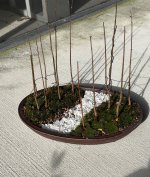
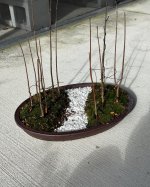
Project complete. Now just have to wait and see if they all decide to grow. They all have good looking buds so hopefully everyone will start leafing out come spring. Lmk what you think and if there are things I could have done better. This is my practice forest. I’m looking around for a nice slate slab to make me a bigger one. I’ve go about 30 red maple saplings still in small pots.
I’m starting with 13 red maples I’ve collected over the last year. These are probably all three year old saplings. All of them came from the central Florida area, so they are well acclimated to our climate here. The tallest one in the forest will be 17” tall with all the others reduced in height to different levels. The soil mix I’m using will be the soil they have been growing in for the last year. It’s a combination of small size lava rock, pumus and akadama and pine fines. It mostly lava rock. The pot is a 17” oval about 2.5” deep. The center section is granite rock and fines to try and simulate a creek/stream in the forest. The chop stick lattice is to wire the saplings into place. I’ll use 1.5 mm wire.
Here are all the saplings with most of the soil mix removed. I’ll trim each one as I put them in the setting. They all have good lateral root structure so I’ll try to set them in a way to take advantage of the near surface roots. As they grow, it may look like solid surface roots for each group.
Left side complete. It has seven trees in it. I’ve wired the roots into the base lattice and then used 1 mm wire to connect the tops so they are all straight up, or at least close to straight up and aligned with each other. Once they have settled and the roots get a firmer grip I’ll be able to remove the top wires. I did a lot of reading on how to arrange the different heights, but found out it’s a little tougher when you’re trying to squeeze all those roots into a small space. Figure I can trim them into a logical looking setting once they start growing.
Right side complete. six trees on this side. Same with wiring the tops so they stand straight. I used small granite rocks and fines to fill in my “creek” to complete the look of trees on both sides of a small stream.
Last thing to do was put my forest floor covering. I used a few different types of moss I had in a lot of my pots.
A little cleaning up and a lite watering. It will stay in a shaded area on my porch so it can get settled in.
Project complete. Now just have to wait and see if they all decide to grow. They all have good looking buds so hopefully everyone will start leafing out come spring. Lmk what you think and if there are things I could have done better. This is my practice forest. I’m looking around for a nice slate slab to make me a bigger one. I’ve go about 30 red maple saplings still in small pots.
Last edited:


