Kintsugi Pot Repair

Heian Kouzan (平安香山) - Shohin Rectangle - Sculpting​

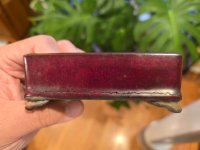
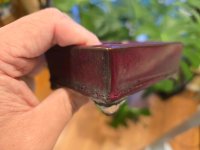
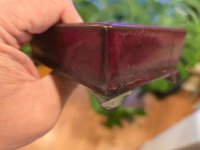
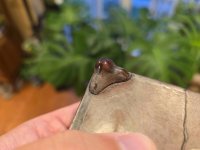
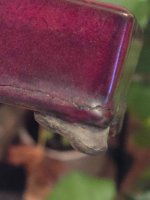
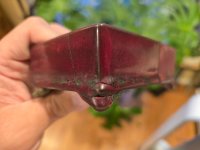
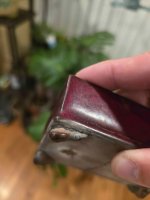
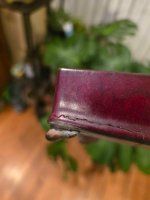
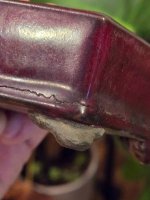
A few more weeks went by, and I was able to whittle the crude foot down. It was a super fun little project but it took a bit of time to whittle. I used a semi sharp scalpel to carve large chunks away, and then a fairly dull scalpel to scrape away the surface before I sanded some of it to shape. In the end, the foot came out looking pretty good.

20251001_185527.jpg
Here's the side profile showing the side with the missing foot. That foot is whittled down to make it look like its companion foot.

20251001_185507.jpg
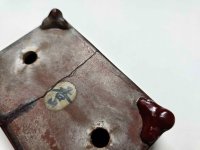
Here's the other side, with the 25% missing foot filled back in. You can sorta tell how the two types of foot look different. Also note, those big holes have been filled in. I packed in the composite into those holes and cracks where I could.

20251001_185545.jpg
Here's a front-on view of the corner perspective of the original foot.

20251001_185537.jpg
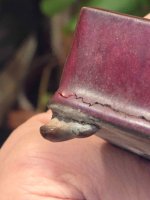
Here's the other side with the sculpted foot. I think it could be a little bit slimmer.

20251001_185554.jpg
Here's the underside. It's still quite crude and needs to be filled in with sabi urushi.

20251001_185557.jpg
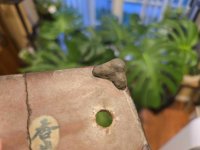
Here's the underside of the companion foot for reference.

20251001_210709.jpg
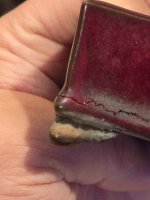
Side profile of the companion foot, original.

20251001_210720.jpg
I wanted to bring this foot's anatomical features to light. One of the things I love most about this foot is the portion that flips upward.

20251001_21072022.jpg
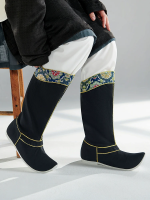
Here's the line highlighted for your viewing convenience. These types of feet remind me of the footwear of times long gone in China. The little flick upward looks quite elegant, giving it an exquisite classical look. Here's that footwear for reference.
1759375877098.png

20251001_210727.jpg
Here's the sculpted foot with that upward motion sanded out. I'll add a little sabi urushi to fill in any pits.

Not bad for sculpting from a big chunk of composite.
 

Attachments

  • 20251001_185645.jpg
    20251001_185645.jpg
    163.6 KB · Views: 5
  • 20251001_210559.jpg
    20251001_210559.jpg
    100.8 KB · Views: 6
  • 20251001_210530.jpg
    20251001_210530.jpg
    115.5 KB · Views: 6
  • 20251001_210749.jpg
    20251001_210749.jpg
    174 KB · Views: 6
  • 20251001_210735.jpg
    20251001_210735.jpg
    173.9 KB · Views: 7

Heian Kouzan (平安香山) - Shohin Rectangle - Sculpting (Continued)​

So after a few more sanding sessions and fillers, I'm pretty happy with how the foot turned out. Interestingly, after I added the polishing urushi to fill in any divots, the red polishing urushi turned out to look pretty much like the glaze. I'm still going to polish some more before I gild, but this is pretty much where I'd like to be with the foot. I can now start on other parts of the pot.

20251014_152008.jpg
20251014_151915.jpg
20251014_151956.jpg
20251014_151945.jpg
20251014_151936.jpg

I'll be applying urushi into all the crevices to fill in all the voids. I would rather flood the space with liquid urushi first before adding sabi urushi. More to come!
 

Suruga Seizan (駿河政山) - Shohin Square - Analysis​

I've recently had the great pleasure of having this Seizan pot come across my repair table from one of our own, @MACH5 Sergio Cuan. Unfortunately, this pot broke; however, it gets to have a new life as a reassembled kintsugi pot. We also get a good education about how some pots are created.


A bit of background on Suruga Seizan: he was born in 1945 and, to the best of my knowledge, is still living. Seizan began his artistic journey as a bonsai practitioner long before turning to ceramics, a path that may sound familiar to many who discover pottery through their passion for bonsai.

After dedicating forty years to the art of bonsai, Seizan shifted his focus to ceramics about eighteen years ago. His motivation that springboarded him into bonsai ceramics was simple yet profound: to create the ideal pot for his own trees (this should definitely sound very familiar). Despite being relatively new to the world of bonsai ceramics without familial associations or past ceramic experience, Seizan has developed a reputation for producing exceptionally beautiful and meticulously crafted works of the highest quality.

I realized I had mischaracterized this pot during my initial analysis with Sergio. One of the most fascinating aspects of examining a broken pot is the opportunity to uncover clues about how it was made. When Sergio and I first looked at this piece, we both noticed the absence of visible seams. Initially, I thought this might suggest the pot had been made using a mold, where, at each seam joint, a coil of clay is pressed into the corners to eliminate the seam, followed by smoothing and finishing work to refine the surface. However, after researching Seizan’s methods further, I discovered something distinctive: Seizan is known for carving his pots from a single solid block of clay.

This approach was born from his observation that the feet of bonsai pots are often their weakest point; over time, they tend to be the first parts to fail, even when the rest of the pot remains intact. You can see this in examples like the Heian Kouzan Shohin Rectangle, where all four feet eventually broke off. In contrast, Seizan’s method of carving the entire pot, including the feet, from one continuous block ensures that the feet are structurally integral and less prone to failure. Realizing this was an enlightening moment, especially having a pot in hand that so clearly demonstrates his concept in action.


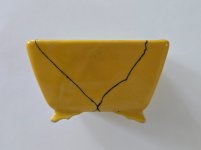
Here is the broken, painted Suruga Seizan pot.

Note:
This pot broke in ways that showcase the carving technique that Seizan employs. At first, Sergio and I thought there was going to be no damage to the front face of the pot; however, upon closer inspection, the face has some pretty deep fractures. Those cracks do come apart and are very much separated. This means there will be a gilded kintsugi joint seam on every face.
20251016_000021.jpg

Obligatory chop mark presentation.
20251016_003045.jpg

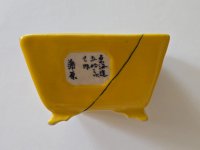
Note: The invisible fractures were not visible until a raking light was applied. The fractured cracks were further scribed open to make them visible and also wider so that lacquer can be applied later. Regarding the scene, it is a rather famous one, part of the 53 Stations of Tokaido by Utagawa Hiroshige.
20251016_000213.jpg

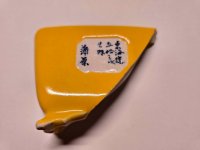
Note the inscription, it reads the 東海道五拾三次之内 蒲原 "Fifty-three Stations of the Tōkaidō: Kanbara". It describes the front-painted scene.
20251016_000319.jpg

Here is an actual image of Hiroshige's 15th plate showcasing the same scene and inscription.
Kambara-scaled.jpg

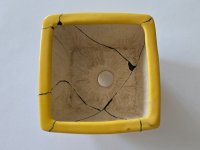
An interior view of the front face. Note the cracks have come all the way through to the back side. They may not reflect the distance traveled in front, but they do traverse quite far past the front face.
20251016_000224.jpg

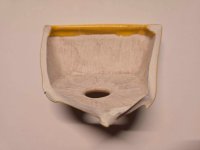
This piece is important as it gives the best evidence of this pot being carved from a single block of clay. Note how there are no seams from the side wall to the bottom plate with the feet.
20251016_000333.jpg
20251016_015944.jpg

The edges have been filed down so that the seam is much wider and can have more material, which means it'll have more strength to hold more. From this angle, I really love the shape of the feet. They are just so delicate and so aethetically pleasing to look at.
20251016_000429.jpg


This concludes the analysis. The front could still use a little more scribing because the fractured seam is still a little too narrow for my liking. I need to be a little careful with the front to ensure the pot doesn't break as the goal is to impregnate the fractured seams with urushi vs breaking it.

Excited to put this back together. The front face piece will likely follow the Daisuke - Shohin Round pot approach, where I clamp the piece together and apply urushi.

More to come.
 

Suruga Seizan (駿河政山) - Shohin Square - Analysis​

I've recently had the great pleasure of having this Seizan pot come across my repair table from one of our own, @MACH5 Sergio Cuan. Unfortunately, this pot broke; however, it gets to have a new life as a reassembled kintsugi pot. We also get a good education about how some pots are created.


A bit of background on Suruga Seizan: he was born in 1945 and, to the best of my knowledge, is still living. Seizan began his artistic journey as a bonsai practitioner long before turning to ceramics, a path that may sound familiar to many who discover pottery through their passion for bonsai.

After dedicating forty years to the art of bonsai, Seizan shifted his focus to ceramics about eighteen years ago. His motivation that springboarded him into bonsai ceramics was simple yet profound: to create the ideal pot for his own trees (this should definitely sound very familiar). Despite being relatively new to the world of bonsai ceramics without familial associations or past ceramic experience, Seizan has developed a reputation for producing exceptionally beautiful and meticulously crafted works of the highest quality.

I realized I had mischaracterized this pot during my initial analysis with Sergio. One of the most fascinating aspects of examining a broken pot is the opportunity to uncover clues about how it was made. When Sergio and I first looked at this piece, we both noticed the absence of visible seams. Initially, I thought this might suggest the pot had been made using a mold, where, at each seam joint, a coil of clay is pressed into the corners to eliminate the seam, followed by smoothing and finishing work to refine the surface. However, after researching Seizan’s methods further, I discovered something distinctive: Seizan is known for carving his pots from a single solid block of clay.

This approach was born from his observation that the feet of bonsai pots are often their weakest point; over time, they tend to be the first parts to fail, even when the rest of the pot remains intact. You can see this in examples like the Heian Kouzan Shohin Rectangle, where all four feet eventually broke off. In contrast, Seizan’s method of carving the entire pot, including the feet, from one continuous block ensures that the feet are structurally integral and less prone to failure. Realizing this was an enlightening moment, especially having a pot in hand that so clearly demonstrates his concept in action.


Here is the broken, painted Suruga Seizan pot.

Note:
This pot broke in ways that showcase the carving technique that Seizan employs. At first, Sergio and I thought there was going to be no damage to the front face of the pot; however, upon closer inspection, the face has some pretty deep fractures. Those cracks do come apart and are very much separated. This means there will be a gilded kintsugi joint seam on every face.
View attachment 617391

Obligatory chop mark presentation.
View attachment 617392

Note: The invisible fractures were not visible until a raking light was applied. The fractured cracks were further scribed open to make them visible and also wider so that lacquer can be applied later. Regarding the scene, it is a rather famous one, part of the 53 Stations of Tokaido by Utagawa Hiroshige.
View attachment 617393

Note the inscription, it reads the 東海道五拾三次之内 蒲原 "Fifty-three Stations of the Tōkaidō: Kanbara". It describes the front-painted scene.
View attachment 617394

Here is an actual image of Hiroshige's 15th plate showcasing the same scene and inscription.
View attachment 617395

An interior view of the front face. Note the cracks have come all the way through to the back side. They may not reflect the distance traveled in front, but they do traverse quite far past the front face.
View attachment 617396

This piece is important as it gives the best evidence of this pot being carved from a single block of clay. Note how there are no seams from the side wall to the bottom plate with the feet.
View attachment 617397
View attachment 617398

The edges have been filed down so that the seam is much wider and can have more material, which means it'll have more strength to hold more. From this angle, I really love the shape of the feet. They are just so delicate and so aethetically pleasing to look at.
View attachment 617399


This concludes the analysis. The front could still use a little more scribing because the fractured seam is still a little too narrow for my liking. I need to be a little careful with the front to ensure the pot doesn't break as the goal is to impregnate the fractured seams with urushi vs breaking it.

Excited to put this back together. The front face piece will likely follow the Daisuke - Shohin Round pot approach, where I clamp the piece together and apply urushi.

More to come.

David, thank you for your highly detailed in-depth analysis. I have learned a lot. I have no doubt you'll do a magnificent job repairing this pot and will be even more beautiful than ever!
 

Nick Lenz - Oval - Finished Repair​

This pot has been on the repair table for a little too long. This belongs to my study group mate and he doesn't have an urgency to get it repaired quickly. We traded services, I got a shohin stand from him (he makes stands) and I repaired his pot, we're a good collection of people that have other skills outside of bonsai.

This pot was hard to repair in the sense that there was a lot of unfinished surface, which made repairing it to a smooth surface difficult. There was a ton of grit and it made sanding hard and getting a level surface was also challenging. I think I could have done a better job preparing this pot. The lines are a little thicker than I would have wanted. This pot is usable and I've told my study group mate that if he wants to use this pot again, to protect the surface with a long strip of paper towel, also when anchoring the tree to the pot, to use the monolithic side where the larger piece is still whole.

IMG_1976.jpg
IMG_1984.jpgIMG_1986.jpg
 
MOTHER F*#@ER!

Well, this happened.

20251016_000953.jpg

Sometimes you think you've caught all the cracks and the path they're cracking in, and sometimes you miss it. I didn't realize there were smaller micro fractures I've missed. When I was scribing the pot a bit more, it forced the piece to crack open those micro fractures and the piece just cracked off.

FWIW, the piece was fairly "loose". I was able to force the piece open a bit, and the piece was able to give way liberally. You can see this image below, how much it can "bend" with a gentle push.
20251016_000808.jpg

Silver lining, if it broke that easily, then it meant it wasn't secure at all. That way, I'll be able to adhere it back together with a stronger bond with the mugi urushi.
 

Heian Kouzan (平安香山) - Shohin Rectangle - Sculpting​

A few more weeks went by, and I was able to whittle the crude foot down. It was a super fun little project but it took a bit of time to whittle. I used a semi sharp scalpel to carve large chunks away, and then a fairly dull scalpel to scrape away the surface before I sanded some of it to shape. In the end, the foot came out looking pretty good.

View attachment 615862
Here's the side profile showing the side with the missing foot. That foot is whittled down to make it look like its companion foot.

View attachment 615860
Here's the other side, with the 25% missing foot filled back in. You can sorta tell how the two types of foot look different. Also note, those big holes have been filled in. I packed in the composite into those holes and cracks where I could.

View attachment 615859
Here's a front-on view of the corner perspective of the original foot.

View attachment 615861
Here's the other side with the sculpted foot. I think it could be a little bit slimmer.

View attachment 615858
Here's the underside. It's still quite crude and needs to be filled in with sabi urushi.

View attachment 615857
Here's the underside of the companion foot for reference.

View attachment 615848
Side profile of the companion foot, original.

View attachment 615849
I wanted to bring this foot's anatomical features to light. One of the things I love most about this foot is the portion that flips upward.

View attachment 615847
Here's the line highlighted for your viewing convenience. These types of feet remind me of the footwear of times long gone in China. The little flick upward looks quite elegant, giving it an exquisite classical look. Here's that footwear for reference.
View attachment 615863

View attachment 615850
Here's the sculpted foot with that upward motion sanded out. I'll add a little sabi urushi to fill in any pits.

Not bad for sculpting from a big chunk of composite.
That’s cool you could identify those motifs in bonsai pots. I’m fascinated with how cultural influences over centuries are reflected in local aesthetic and material culture.

Fun fact: Leather boots in traditional China, such as those boots in that image, originated from Mongol-ruled Yuan dynasty. They’re equestrian attire, designed for horse riding and active nomadic life. The practicality of this style became popular amongst the Han Chinese population and also extended to the social elite of the Korean Peninsula and Japanese archipelago.
 

Suruga Seizan (駿河政山) - Shohin Square - Assembly​

Simple assembly, ended up being very clean and once all the excess was removed, all the pieces sat very flush with each other.

The one thing I wanted to make sure I did was do one last scribing of the areas I was going to impregnate with urushi. However it would be AFTER I've put the pot back together hoping it'll help with applying counter pressure.

Ended up being successful, here is an image showing how much the crack took on urushi without me actually applying urushi from the back. See how deep that crack went, I love when the crack gets filled up, proper scribing definitely helps.
20251029_123546.jpg
Here is another image showing the difference between impregnation of urushi vs adhesion with mugi urushi. The impregnation line is always crisper and cleaner.
20251029_123604.jpg

Here are other images showing the pot back together.
20251029_123103.jpg
20251029_123116.jpg
20251029_123121.jpg
20251029_123131.jpg
20251029_123142.jpg
20251029_123149.jpg

A close up of the front.
20251029_123459.jpg
 

Revisiting An Old Pot - Shohin Round​

Nearly 3 years ago, I repaired a shohin round pot I got from a raffle. This little pot was one of my test projects, where I left it outside exposed to the elements. For 3 years, it held and was still intact, until it wasn't. On a windy day, the wind blew some trees off my bench and fell about 3 feet onto my deck, and the impact broke the pot apart and a piece of it went missing. It's good to know that the pot could withstand freeze-thaw cycles, but it was understandable that a 3' fall would ultimately undo the repair. So I did what I do and put the piece back together and I just wanted to share the quality between the two repairs over 3 years.

2023 Repair
327524501_716229806637672_7254405975809943035_n.jpg

2025 Repair
IMG_2311.JPG
IMG_2307.JPG
IMG_2298.JPG
IMG_2308.JPG
IMG_2295.JPG

Observations:
My first repair lacked finesse. What I noticed looking back:
- Didn't file away the edging, not enough surface area to have material hold.
- Didn't scribe cracks deep enough.
- Quick to gild, should have gone through more processes polishing steps.
- I didn't use any composite to resculpt missing pieces.
- Quick to gild, the surface was grainier.
- After adhering with mugi urushi, I now go back with raw lacquer to make sure all seams are impregnated with raw lacquer.
- I now go back with a sharp edge to clean up any gilding that went over the lines like an eraser, to get clean thresholds.
- My lines are definitely a bit thicker now due to filing edges. But it's not egregiously thick, it also serves as a functional purpose.

This pot will rehome the azalea that was slip-potted into another pot. Come spring, it'll go back into this pot for further observation.
338754046_196419389775641_1559653076343790916_n.jpeg
 
Observations:
My first repair lacked finesse. What I noticed looking back:
- Didn't file away the edging, not enough surface area to have material hold.
- Didn't scribe cracks deep enough.
- Quick to gild, should have gone through more processes polishing steps.
- I didn't use any composite to resculpt missing pieces.
- Quick to gild, the surface was grainier.
- After adhering with mugi urushi, I now go back with raw lacquer to make sure all seams are impregnated with raw lacquer.
- I now go back with a sharp edge to clean up any gilding that went over the lines like an eraser, to get clean thresholds.

Great advice!!!
 
Observations:
My first repair lacked finesse. What I noticed looking back:
- Didn't file away the edging, not enough surface area to have material hold.
- Didn't scribe cracks deep enough.
- Quick to gild, should have gone through more processes polishing steps.
- I didn't use any composite to resculpt missing pieces.
- Quick to gild, the surface was grainier.
- After adhering with mugi urushi, I now go back with raw lacquer to make sure all seams are impregnated with raw lacquer.
- I now go back with a sharp edge to clean up any gilding that went over the lines like an eraser, to get clean thresholds.

Great advice!!!
This is what my wife does with her pottery. You did a great job.
 

Suruga Seizan (駿河政山) - Shohin Square - Filling​

The piece is now cured enough to proceed to being filled with sabi urushi. Having worked on quite a few pieces now, I've come to realize that even on glazed surfaces, when there are divots in glazing, the sabi urushi fills in those spots and they're generally very hard to get out. It'd require some mechanical picking to get the stuff out. Sometimes it's left on for good because it also stains the surrounding area. My consulting teacher had always mentioned to me that even when it's not visible, it's noticeable, at least to me, and that's not a good feeling. So in the case of this pot, I've taped the surfaces I'm filling in so that nothing gets into those spots.

You can see what I mean. I've taped the front area where there is a painted motif. The last thing I want is to add unnecessary artifacts of repair.
20251129_121849.jpg

As for the glazed yellow surface, there are no open pores, so it'll be okay to just go over it with sabi urushi. I'll come back and go over the surfaces with a wipe because I've found the unnecessary excess stuff comes off with the application of the cleaning chemical. That way, I won't have to use more mechanical effort to sand or scrape and possibly damage the glazed surface.
20251129_121858.jpg
 

Suruga Seizan (駿河政山) - Shohin Square - Filling​

Didn't take a picture of the filled in state, the excess was easily wiped off and the seams are substantially filled in more.

20251218_235713.jpg20251218_235707.jpg20251218_235701.jpg20251218_235654.jpg

There were some pretty small crevices that I couldn't fill with the sabi urushi, so I will have to come back around with polishing urushi to fill in those small areas. I realized in the last picture, the darker line appearing is superficial and only on the glaze, it does not telegraph through the entire pot. I will likely have to scribe this line and fill it with raw urushi to ensure it doesn't crack any further. It didn't initially show it was having after filling in the space with sabi urushi did it show up. Which is sort of weird since sabi urushi is very thick as a paste and should not have had any liquid to fill in superficial crevices.
 

Suruga Seizan (駿河政山) - Shohin Square - Filling with Polishing Urushi​

The next step is to fill the space now with polishing urushi. I would put this stuff on very very thick and allow it to slowly, VERY slowly, cure. Any quick curing will lead to wrinkling and I needed this to cure throughout the dense material. It's like curing too quickly leaves the interior to be still "gooey" and the surface wrinkles and won't fill the spaces evenly.

20251219_004436.jpg20251219_004441.jpg20251219_004452.jpg20251219_004455.jpg20251219_004423.jpg

I'm anticipating that once cured, these seams will be very indiscernible. I have another pot I've repeated this process a few times and those seams don't register from touch.
 

Heian Kouzan (平安香山) - Shohin Rectangle- Masking​

This pot needs a lot of protection to ensure the patina isn't disturbed. Most of my other pots appear to have been slightly used, while this pot is definitely used and very old. What I like about using tape to mask seams is that when I tear the tape, the jagged edge of that piece of tape matches a segment of the break. It's very strange how it works out. EVERY piece I tear fits something, it's very neat lol.

Here's an example of what I mean.
It's like so very bizarre how it works out.

So here's a piece of tape I cut straight, even the straight cuts have a use in some repair line. However, for this pot, there isn't a use. But this is just a proof of concept.
20251227_152137.jpg

Here's a torn edge. Note that it is the same piece of tape. I'll take the torn piece and rotate it to find a segment along the seam to see which segment it can help mask.
20251227_152203.jpg

And there it is, just off to the side, this piece fits this segment. I'll tear more and more pieces to see which segments align until the entire pot is masked.
20251227_152351.jpg


Here is the entire pot masked. This took about an episode of Stranger Things to complete.

20251213_233359.jpg20251213_233349.jpg20251213_233338.jpg20251213_233325.jpg20251213_233317.jpg20251213_233308.jpg

While I do understand that it's NOT an exact fit, some don't match exactly, it does get the job done and multiple pieces help mask the entire seam line. Next step is to fill the space with sabi urushi.
 

Attachments

  • 20251213_233331.jpg
    20251213_233331.jpg
    137 KB · Views: 1

Magnolia Leaf Project - Tea Scoop (茶则)(Cha Ze)/Possible Display Accent Piece - The Progress So Far​

I've been working on this side project that's captivated my interest. Its main use is for the Chinese tea ritual, where you'll use it as a tea scooper to transport tea from the container to the teapot. When not in use, I can definitely see this being used for an accent piece. My goal is to do a proof of concept that I can use my experience of kintsugi and apply it to a project that has no real affiliation with the craft, other than it uses the same material resources. So this has been about 4 months already that I've started this side project. It's painfully slow how long everything takes to cure and dry.

Step One:
I picked out a magnolia leaf that is pretty large (in retrospect, I think I'll choose a smaller leaf in the future) and inspected it for blemishes and washed the surface off of any debris.
20251011_090017.jpg20251011_090011.jpg

Step Two:
I'll have to bind the leaf up so that the leaf can dry in this shape. This drying process will take 3 weeks to fully dry and hold its shape. This leaf stays green after 1.5 weeks. It wasn't until the 2nd week did I notice the leaf starting to change colors.
20251011_161928.jpg

Something to note:
The furry underside of the magnolia leaf is going to be the part that'll be "rightside up." However, I want the veining of the leaf, on the green side, so I'm trying to make an impression on the other side to grab all the details all the while, using the curled leaf structure.

Step Three:
Once the leaf is set, I took some gold pearl powder and mixed it with raw urushi and painted the now, yellow unfurry side of the leaf. So that once I'm done, releasing the leaf from the "mold," the gilded gold side will be exposed with all the veining of the leaf.
20251123_175914.jpg20251123_175908.jpg

Step Four:
This is where I start building the structure to hold rigidity. This was a substantial amount of tonoko powder (clay) mixed with raw urushi to make this compound to apply to the leaf. Note that this layer is just clay and lacquer, the layering is important as I'll be building up rigidity with every layer.
20251214_000930.jpg20251214_000922.jpg

Step Five:
This next step is to apply a textile layer for even more structural support. In this case, I used a rather dense, industrial towel-like paper, yet still permeable, as the textile like material. I could have used hemp or a cheese cloth, but I think grabbing either of those for this one project was not very necessary, at least not yet. We'll see how this piece of paper holds.
For this layer, I'd mix the same mixture of lacquer and tonoko (clay) and mix it well, and apply it to this piece of paper. Because it was permeable, the compound was able to soak through and I was able to repeat apply the same compound that seeped through, over and over again to make sure the piece of paper really took on the mixture well.
20251214_000330.jpg

This part was the messiest; however, it was also the most important. I'm pretty immune to raw lacquer, but this part was so messy, I needed to make sure I was protected. Because it's not me who I should worry, urushi oil can get onto anything, and the last thing I want is it to get onto surfaces my wife touches, or my dog would lick. This part needed a lot of contact; I needed to make sure this layer adhered really well to the previous layer. I would have a side plate of sabi urushi at the ready after I've applied pressure. I'd come back with gobs of sabi urushi and apply it on top to make sure the material is making full contact and adhered below. Here's the result; the excess will be trimmed off later.
20251218_234853.jpg

Step Six:
After a week or so, the material has cured, and the excess can be trimmed off. There were still some softer parts that needed more time to cure, so after trimming, I assessed the piece to make sure it was absolutely ready before I could move onto the next step.
20251218_235632.jpg

Step Seven:
This part will add even more structural rigidity. This is a new composite I'm experimenting with, I'm using the fine stuff I sift from my Aoki mix, shohin mix, to extract the dust and fine particulates from the bag to use. Because Tonoko powder is basically crushed and powderized clay, the sifted Aoki mix is similar as it's more akadama, which is clay, vs other gritty material. To ensure I add extra reinforcement, I added in a 1/2 portion of elm dust or wood powder as a means to add in fibrous material to this new experimental mixture. Once all mixed together, I applied it to the leaf and the difference between the sabi urushi and this mixture is, this mixture is extremely gritty, which is what I expected and wanted because it's very similar to concrete. Aggregates are crucial in concrete as they provide bulk (60-75% of volume), form the structural framework (skeleton) for strength, reduce cement/water needs, and enhance stability by controlling shrinkage and cracking, while their size, shape, and type dictate workability, density, durability, and thermal properties for better load distribution and longevity. This mixture is no different as I'm trying to achieve the same effect.
20251230_112842.jpg

Step Eight:
After the previous layer cures, the gritty surface will need to be filled in with sabi urushi again. This might be the last layer where I mix in tonoko powder with the urushi to make a compound to apply to the surface. After this step will be my first sanding to really smooth out the surface. You can see the sabi urushi is applied generously, and the leaf is now very rigid; however, not really of pliable.
20251230_112851.jpg

Current State, Step Nine:
This leaf has been sanded with 200 grit sandpaper. The surface is much smoother and all ridges that were pronounced in the last step are smoothed out. After sanding this, there are quite a bit of divots and holes. I will definitely be going back in with another layer of sabi urushi to make sure all the missing spots are filled in.
20251230_160642.jpg
20251230_160651.jpg

In the next post, I'll explain the layering in a cross-section and then give you an idea of what I plan to do to for the finish.
 

Magnolia Leaf Project - Tea Scoop (茶则)(Cha Ze)/Possible Display Accent Piece - The Progress So Far (Continued)​

So here's a breakdown of the layering so far.
1767165428498.png

I'm basically getting the surface ready because I'm trying to create a very intricate design that involves a lot more layers. I'm guessing my future posts on that process, and applying those layers will likely be very entertaining to see as the design will appear only after sanding away the material.

Stay tuned.
 
Back
Top Bottom