How light can you go???

mwar15

Omono
Messages
1,201
Reaction score
2,593
Location
Willamette Valley, Oregon
USDA Zone
8B
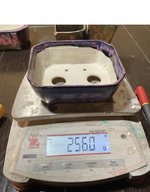
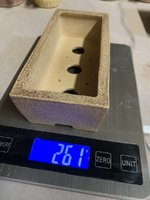
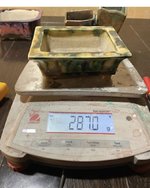
A few potters were discussing on FB making light pots (under 300grams).This is related to the Japanese shows for pots and challenging yourself. Josh Jeram and Roy Miranri were sharing some of their pots. I included some pots for comparison.

Granted someone could make a 1x2” put easily, but the challenge is a functional pot high quality and the largest you can go.

@Pitoon have you weighed your pots? What were the weight of the pots you sent over to Japan? Did they give you feedback on thickness of your clay?


1-Bushuan
2- Josh Jeram
3- mine (before trying)
4- mine wet (5.25x3.25x1.75”)
5/6/- Roy
7- @sorce
IMG_7630.jpegIMG_7631.jpegIMG_7635.jpegIMG_7569.jpegIMG_7633.pngIMG_7634.pngIMG_7636.jpeg
 
@Pitoon have you weighed your pots? What were the weight of the pots you sent over to Japan? Did they give you feedback on thickness of your clay?

I've never weighed my pots, don't have a real reason to.

The pots I sent over to Japan are still in the box, I still haven't opened the box yet. I have no idea what they weigh.

No feedback from the Japanese. Only feedback that I always keep in mind is @William N. Valavanis feedback. I asked him to critique my pots last year, and he seemed very impressed. He mentioned I'm one of the few American pottters that he knows that makes pots that thin. He said my pots are very comparable to good Japanese pots. He's not the first that has compared my pots to Japanese pots. A lot of people think they are from Japan, if I don't mention that I made them.

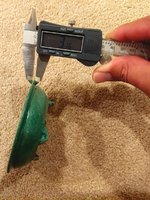
I took some pics with a caliper so you can see the thicknesses between multiple pots. Measurement is in millimeters.

20231122_203359.jpg20231122_203422.jpg20231122_203454.jpg20231122_203512.jpg20231122_203532.jpg20231122_203559.jpg20231122_203615.jpg20231122_203659.jpg20231122_203722.jpg20231122_203737.jpg
 
If I was a pot maker, I'd be more worried about having the sides thick enough to prevent warping during firing than how much the overall pot weighs.

I don't know what causes warping but it certainly detracts from a good pot. As a buyer of pots, it's a huge turn off, particularly at the prices some pots are going for these days.
 
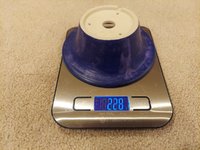
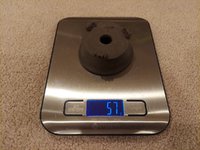
I also took weights, even though we're talking apples and oranges in terms of pot size.

Let's see what next year brings. I plan to be very serious with the pottery as I've invested quite a bit this year in preperarion for next year.

View attachment 518483View attachment 518484View attachment 518485View attachment 518486View attachment 518487View attachment 518488View attachment 518489View attachment 518490View attachment 518491View attachment 518492
Thanks for the post. I agree it’s dependent on the pot size. I measured mine and they are 3-6mm right now. Excited to see your pots when you start making more!
 
@snowman04 , you have a scale?
I wonder how much that big lippin weighs.

Sorce
 
If I was a pot maker, I'd be more worried about having the sides thick enough to prevent warping during firing than how much the overall pot weighs.

I don't know what causes warping but it certainly detracts from a good pot. As a buyer of pots, it's a huge turn off, particularly at the prices some pots are going for these days.
It’s not necessarily thickness that governs whether a pot warps. It’s primarily the clay and how hot it was fired. Not all clays vitrify fully or much at all when they are fired to maturity. Which matters with outdoor or culinary/kitchen uses to get that very low, or any at all absorption rate. Past maturity they start to bloat, warp, and melt. That’s how we know what a clay can handle as far as temp. Also how a pot was made and dried can cause it to warp a certain way during firing. And also firing can cause warpage simply due to the clay body. Usually when I get warpage it’s from overfiring a bit. I have all the other reasons dialed in pretty well. I try to fire right at peak temp.
 
We will have to get it on the scale
I challenged myself and made roughly a 12”x9”x2” oval once with close to 1/16” wall 1/8” base. The guy who has it really liked it. There is a cool feeling I think with holding a light pot that should seem heavier.

I hardly use the metric system in my pottery. I did during the years of jeweling and engraving I did due to working with fractions of a mm. I still agree it’s a better system overall though.
 
As a pot (pottery) consumer, thin walls and light weight are not advantages, except for the smallest pots. A two foot tall pine needs a substantial pot, one that won't blow over in a light breeze. You need visual weight to ground the image.

Even azaleas, where glazed and decorated pots can be used, are heavy enough to not tip over with a tall azaleas.

Only in shohin and smaller trees does thin and lite become a priority.
 
As a pot (pottery) consumer, thin walls and light weight are not advantages, except for the smallest pots. A two foot tall pine needs a substantial pot, one that won't blow over in a light breeze. You need visual weight to ground the image.

Even azaleas, where glazed and decorated pots can be used, are heavy enough to not tip over with a tall azaleas.

Only in shohin and smaller trees does thin and lite become a priority.
Very true. It’s also about balancing structural integrity with all the aesthetic means. Shohin can go light. Also don’t want larger pots to bulky.
 
As a pot (pottery) consumer, thin walls and light weight are not advantages, except for the smallest pots. A two foot tall pine needs a substantial pot, one that won't blow over in a light breeze. You need visual weight to ground the image.

Even azaleas, where glazed and decorated pots can be used, are heavy enough to not tip over with a tall azaleas.

Only in shohin and smaller trees does thin and lite become a priority.
I agree, a lot of this is more about practice. I’m always amazed at grabbing a shohin pot off a table with 1/2” walls.
 
Back
Top Bottom