Can you give me a precise, accurate definition for the term literati bonsai?

Gabler

Masterpiece
Messages
4,018
Reaction score
6,524
Location
The Delmarva Peninsula
USDA Zone
7b
Literati is a difficult subject to pin down. The most common definition I see is that it has to "feel like" a literati tree. This reminds me of the late Justice Potter Stewart and his infamously vague definition of pornography:

I shall not today attempt further to define the kinds of material I understand to be embraced within that shorthand description ["literati bonsai"], and perhaps I could never succeed in intelligibly doing so. But I know it when I see it ...

The way I see it, the term "literati bonsai" is a bit like the Trinity. We can parrot the phrase, "one God in three persons," but a lay attempt at explaining what that means will usually result in heresy. Similarly, whenever I see someone try to explain the literati style, it results in accusations of bonsai heresy.

Speaking of Michael Hagedorn:

The question recently reared its head on another thread, and rather than pollute Johnny's thread with a semantical argument, I elected to start a new thread here.

Anyway, here is my own humble attempt at defining literati:

If it's a sparse tree with an abstract design and a wabi-sabi sense of aesthetics, I consider it literati.

Please share your own definitions, and feel free to explain why you disagree with mine.
 
Literati is a difficult subject to pin down. The most common definition I see is that it has to "feel like" a literati tree. This reminds me of the late Justice Potter Stewart and his infamously vague definition of pornography:


The way I see it, the term "literati bonsai" is a bit like the Trinity. We can parrot the phrase, "one God in three persons," but a lay attempt at explaining what that means will usually result in heresy. Similarly, whenever I see someone try to explain the literati style, it results in accusations of bonsai heresy.

Speaking of Michael Hagedorn:

The question recently reared its head on another thread, and rather than pollute Johnny's thread with a semantical argument, I elected to start a new thread here.

Anyway, here is my own humble attempt at defining literati:

If it's a sparse tree with an abstract design and a wabi-sabi sense of aesthetics, I consider it literati.

Please share your own definitions, and feel free to explain why you disagree with mine.
The way I've always understood it, it's supposed to "feel like" an old sage would write poems under it. I think by that definition it should look almost like writing...

Although I definitely think of literati as any tree that is long- without strong taper... Sparse foliage and tons of wild yet intricate movement.

I've heard a lot of people say the best literati can't be made, they must be found because only nature can truly provide the wild yet elegant movement. . .

I am still quite new to the hobby so I might not understand literati perfectly and definitely could have this wrong
 
Literati is whatever I want to be literati.
Which is the case with many of these loose definitions; there is no right or wrong if nobody knows the absolute definition.
 
I think the only thing I've seen everyone agree on are these two things:
1. The tree shatters rules of dimensions and taper.
2. Sparse foliage, especially the bottom 2/3.

My own subjective opinion:
1. Elegant, like a flamingo compared to a duck.
2. Artistic license. Does the tree make you feel anything, regardless of what that is it makes you feel?
 
My 2 cents. Like music and many other art forms what is left out can say more than what you see or hear and can make you think or contemplate it.
In music too many notes or instruments can get in the way of an incredible song, remember classics like (and I'm dating myself here) "Bridge Over Troubled Waters" or "First Time Ever I Saw Your Face".
Simple but powerful.. Visual art is the same and most times you can not explain what makes it so but when you hear it or see it you just know.
 
I am not sure that a definitive description can be made. After all, I would argue that the term "literati" is part of the art of bonsai taxonomy, rather than the scientific taxonomy. It's a literati when the majority of experienced artists look at it and feel that it is literati.

That being said, most literati are lanky trees with minimal taper and sparse foliage in the bottom 2/3 of the tree with exaggerated movement throughout. But I would not argue for that as a definition per se, but a generalization of features.
 
The answer is not really in a written definition. The term was taken from artwork depicting trees. Nanga paintings from the Tokugawa and Edo periods in particular set images of “literati” pines. A lot more is being said with literati pines in particular. Pines are a symbol of longevity and perseverance in Asian tradition. Also literati pine trunks in paintings resemble (sometimes verbatim) written characters. Plum trees are also used for literati. The two species are linked together along with bamboo in both Japanese and Chinese tradition. Together symbolizing perseverance, strength, and renewal for enduring winter and flourishing in spring. They often appear together in art with both tree species in sparse literati forms

“Literati pine paintings are a style from Chinese (and later Japanese) scholar-artist traditions, focusing on expressing inner spirit through minimalist ink brushwork, featuring tall, slender trees with sparse branches, emphasizing trunk line over realistic detail, and integrating poetry/calligraphy to convey emotion and cultivation rather than mere depiction. Key features include sparse foliage, few branches, emphasis on the graceful, angular trunk, and use of calligraphy techniques (xie yi style”
 
Your definition is wrong because it has no substance. It is all feeling with no body akin to painting with invisible ink. Asking most of us to give personal perspective on this is no better than having a "looser" definition and generally inaccurate and bastardising of the true meaning. It's like saying lets re define Literati by committee. I've seen Ryan Neil style two nursery stock literati that followed I believe accurate oriental tradition. I believe Michael Hagedorn also has a good handle on it. Besides that Michael is doing or has done a 4 part series on it in his blog that should not be sidestepped for our own purposes. Most of us obviously do not know from what I've seen presented as Literati in threads hereabouts.🤨
 
Last edited:
Your definition is wrong because it has no substance. It is all feeling with no body akin to painting with invisible ink. Asking most of us to give personal perspective on this is no better than having a "looser" definition and generally inaccurate and bastardising of the true meaning. It's like saying lets re define Literati by committee. I've seen Ryan Neil style two nursery stock literati that followed I believe accurate oriental tradition. I believe Michael Hagedorn also has a good handle on it. Besides that Michael is doing or has done a 4 part series on it in his blog that should not be sidestepped for our own purposes. Most of us obviously do not know from what I've seen presented as Literati in threads hereabouts.🤨

If Ryan Neil cannot live up to your standards, is it possible that your definition is too narrow? I'm far from a Mirai fanboy, but the guy obviously knows what he's doing.
 
No offense intended, but people who try to define bunjin should go work on their trees instead. At least that is what I do when tempted by this subject.

No offense taken, but what's the point of a bonsai forum if we can't even define our own jargon? This is exactly the right place for this kind of discussion.
 
Your definition is wrong because it has no substance. It is all feeling with no body akin to painting with invisible ink. Asking most of us to give personal perspective on this is no better than having a "looser" definition and generally inaccurate and bastardising of the true meaning. It's like saying lets re define Literati by committee. I've seen Ryan Neil style two nursery stock literati that followed I believe accurate oriental tradition. I believe Michael Hagedorn also has a good handle on it. Besides that Michael is doing or has done a 4 part series on it in his blog that should not be sidestepped for our own purposes. Most of us obviously do not know from what I've seen presented as Literati in threads hereabouts.🤨
I just love an answer that explains how one answer is absolutely wrong without lending any understanding to a correct answer 🤔

Pretty lazy content for so many words.
 
A bonsai whose essence is defined by a singular line, without dependence on the foliage or branching..

I would append this to my own attempt at a definition:

The literati style focuses on the trunkline, treating it like the stroke of a calligraphy pen. The foliage is the tittle on the "i"—so to speak. It distinguishes the tree as a tree, rather than a wood sculpture, but it is not the focus of the composition. A literati tree is therefore a sparse tree with an abstract design and a wabi-sabi sense of aesthetics.
 
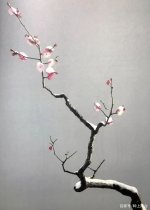
Speaking about plum - found this article with some art reference
https://wapbaike.baidu.com/tashuo/browse/content?id=4dc0f3e863de54087f4e89df (translate works)
and nice (i guess) tree
View attachment 624223


and that mentioned artwork is great
quite a lot resources available, i wish online translators work better
Nagahama and bonbai (not a misspelling)

Eisei En Bjorn video on ume exhibition
 
Last edited:
I cannot give a precise definition of literati, but I recently started reading Literati Style Penjing by Zhao Qingquan and a description there stuck with me. The forward states “the features convey the feelings of remoteness and aloofness” and the book repeats the aloofness characteristic a few times. I found that descriptor of the feeling conveyed through the tree interesting beyond just its physical characteristics.
 
I cannot give a precise definition of literati, but I recently started reading Literati Style Penjing by Zhao Qingquan and a description there stuck with me. The forward states “the features convey the feelings of remoteness and aloofness” and the book repeats the aloofness characteristic a few times. I found that descriptor of the feeling conveyed through the tree interesting beyond just its physical characteristics.
My favorite bonsai book ever.
 
Back
Top Bottom