Advice Young Japanese Maple

Mr.Dr.K

Sapling
Messages
45
Reaction score
23
Location
United States, Oregon
USDA Zone
8b
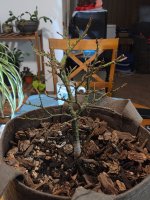
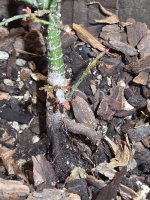
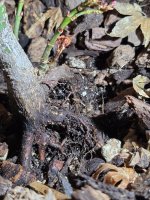
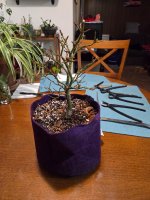
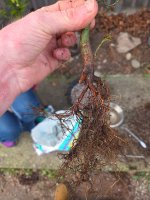
I have this young Japanese Maple that has been in the current Root pouch for two growing seasons; it does feel like there is probably more room in the pot for another season. ATM, I am just allowing this thing to grow out and fatten up. There are a few larger lower roots/branches that I believe will help bulge the lower trunk. My question is, should I leave the roots alone another season, or prune this Winter?
 

Attachments

  • 20260219_183018.jpg
    20260219_183018.jpg
    264.5 KB · Views: 95
  • 20260219_182732.jpg
    20260219_182732.jpg
    268.6 KB · Views: 81
  • 20260219_182911.jpg
    20260219_182911.jpg
    228.4 KB · Views: 65
  • 20260219_182945.jpg
    20260219_182945.jpg
    318.3 KB · Views: 65
  • 20260219_182933.jpg
    20260219_182933.jpg
    267.6 KB · Views: 64
  • 20260219_182745.jpg
    20260219_182745.jpg
    305.3 KB · Views: 80
You have a couple of options here. One, cover the roots and let it go another season. Those surface roots will thicken if they are covered. Two, work the roots now. The correct time to do this is when you repot as the buds are opening. This tree looks about ready.
A couple of thoughts, building the root spread is one of the important first steps toward building a tree. One way to help a tree along is "planting" the tree on a board. The Ebihara is explained very well in this thread by MarkyScott. The roots you have there may already be too big, maybe not. I'd probably try. If you wait another year, I feel sure they would be too think.
Someone may comment that this tree might be a good candidate for a ground layer. That may be true, but I would encourage you to try the Ebihara technique first. It is a good skill to learn.

FYI - that lowest branch is growing below the graft. I'd cut it off.
 
I agree with @coachspinks . It’s best to get the root structure set exactly how you want before allowing the tree to thicken too much. You can always layer later, but if the current roots can be worked in a way that you like, you save yourself an extra step.
This way you continue building the tree and the nebari at the same time. Historically, far too many pre-bonsai (in the US) have only had their nebari worked as an after thought. Much better to build it right the first time.
 
Last edited:
Not much to add that hasnt already been said. When you repot, you can choose to trim a few of the surface roots. This will tell the tree to send out more (smaller) roots in their place. In time this will also increase the nebari.

Nice little tree!
 
FYI - that lowest branch is growing below the graft. I'd cut it off.
I could be wrong, but I don’t see a graft, and those low branches seem to have the same growth pattern.
I would guess that this is a seedling from a Mikawa type. 🤷🏼
 
I could be wrong. From the difference in bark and the subtle change in direction, I assumed it was a graft. It may just be the natural progression of the tree developing bark.
 
Not much to add that hasnt already been said. When you repot, you can choose to trim a few of the surface roots. This will tell the tree to send out more (smaller) roots in their place. In time this will also increase the nebari.

Nice little tree!
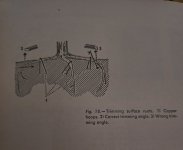
Just wanted to add this diagram from Yuji Yoshimura. It is a good reference/example of angling cuts when you trim surface roots so they will regrow properly and not end abruptly
 

Attachments

  • 20260220_115632.jpg
    20260220_115632.jpg
    144 KB · Views: 78
Very interesting, thank you all for the insight and the link to the thread. It makes sense to start now and progress the roots with the tree. I'll see what I can find locally this weekend and maybe give this a shot. Cheers.
 
I have this young Japanese Maple that has been in the current Root pouch for two growing seasons; it does feel like there is probably more room in the pot for another season. ATM, I am just allowing this thing to grow out and fatten up. There are a few larger lower roots/branches that I believe will help bulge the lower trunk. My question is, should I leave the roots alone another season, or prune this Winter?
At this stage of development you should repot and prune the roots for improvement every two years. Set the structure in the early development for best long term results. providing the tree response each time and is healthy and vigorous before the next time frame.
 
I could be wrong, but I don’t see a graft, and those low branches seem to have the same growth pattern.
I agree. I cannot see any evidence of graft on the trunk and the close internodes of those lower shoots are identical to the rest of the trunk. This is almost certainly a cutting or seedling.

There's very likely plenty of room in the pouch for another season but I agree that nebari is important for Japanese maple bonsai. @River's Edge put it very well - 'Set the structure in early development for best long term results'
Looks like this may have been simply transplanted into the root pouch without much thought to future roots and nebari. Now would be a good chance to set that right, before the roots get too thick, before the top has developed too much.
While the Ebihara board technique looks amazing to beginners, it does have some drawbacks in practice so not every attempt works as well as proponents would have us believe. We can achieve very similar or better results by good root pruning with less bother IMHO.

There are a few larger lower roots/branches that I believe will help bulge the lower trunk.
The thing I find bulges lower trunk most is a good nebari. When all the tree's resources come from lateral roots all around the trunk those roots and the lower trunk tend to swell much more than when the tree has down growing roots supplying some of its needs. Encouraging a good, well spread, all round nebari seems to be win/win.

I would encourage you to root prune this Winter/Spring.
 
I also see no evidence of graft. I would keep the two lower branches to help thicken the base for the time being. Viually it appears to be similar to Shisishigara in both form and colour. The shorter internode coupled with the thicker growth pattern is the tell tale sign for Shisishigara in my mind. Along with the colour match in new growth and ageing bark consistent through to the root structure.The roots are the main weakness at this point and could use the most improvement.
Concur that developing a more even radial spread is one of the best ways to improve the basal flare. To that end prune the obvious roots that grow downward or are off the plane of the best combination for radial root development. Where possible choose to keep roots that are more similar in size rather than focussing on keeping bigger ones that will tend to give a more lopsided nebari outcome. Lots of time to set the structure and grow it out. It looks like there are some nice medium size roots below the obvious large ones.
 
Thank you, everyone. I did knock it out of it's pot today. I understand the recommendation to root prune early in development on this species, now. The larger tap roots had tons of fibrous feeder roots—albeit all of them were toward the bottom of the pot and not at the trunks base. I did prune a few of the larger tap roots off the base of the trunk. I felt like I had to leave a few for the health of the tree. To remove all of them would leave no roots. It will take me several years of pruning to get desired results from what I can see—growing out, trimming larger roots and repeating until the fiberous roots take over. I found myself distracted today. I meant to take more pictures, but all my neighbors were out today and we were chatting. I forgot to take before and after shots. I did repot in a smaller pot this time around, the 2 gallon seemed overkill for such a small root mass. The two root photos, I trimmed some more off horizontally, but forgot a picture afterwards, so there are slightly fewer roots than in the picture. I'll leave this guy alone and see how it recovers. The two lower sacrifice branches also remain.

 

Attachments

  • 20260221_184548.jpg
    20260221_184548.jpg
    232.6 KB · Views: 9
  • 20260221_135503.jpg
    20260221_135503.jpg
    198.3 KB · Views: 7
  • 20260221_135508.jpg
    20260221_135508.jpg
    209.2 KB · Views: 7
I understand that most beginners are conservative when it comes to cutting roots. For all I know JM may respond differently in different climates but I have no problem cutting roots back to stubs on maples. Like branches above, I rarely see new roots emerging except where they have been pruned.

Just so you know what can happen, here's a few photos taken the year after hard pruning some JM in my grow beds.
IMGP8512.JPGIMGP8516.JPGIMGP8519.JPG
The roots were chopped where you can see the change from thick to a cluster of thin roots. Note that almost all new roots have developed from the cut ends of those roots.
Can't remember if those photos were 1 or 2 years after the initial root prune. After the photos all those new roots were chopped to less than 1 cm from the initial cuts to encourage even better ramification.
This one is trident maple. This was part of a trial to see how much roots can be cut back without killing trident maples.
IMGP8055.JPG
That one also survived.

Viually it appears to be similar to Shisishigara in both form and colour. The shorter internode coupled with the thicker growth pattern is the tell tale sign for Shisishigara in my mind.
The short internode pattern also appears characteristic of other 'dwarf' JM. Shaina has similar growth pattern but bark more green initially. I have several seedlings from other dwarf cultivars that show similar growth patterns.
 
Back
Top Bottom