Bursera | General Info & Bonsai Cultivation

Hemmy-
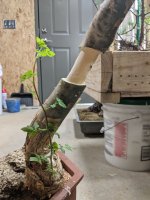
Great to see someone else on the B. microphylla roller coaster! Congrats on getting that flower! I have been held hostage by a specimen I found on Ebay a few years ago. View attachment 607402It came from a grower in FL and its life took a drastic turn waking up @ 7600' in central NM. Kept on heated seed mat in a S facing window in winter w/o water has kept it sufficiently interested in staying alive until I can get it back outside in time to receive summer monsoonal rains and the occasional pounding by hail. It has seen major branches removed as well as a particularly bad strike at a major trunk fork which is healing in a heart shaped roll over (Awww, such a kiss!😘 Say it ain't so!) I rely on single digit humidity and an occasional Dithane treatment to stave off decay and keep the wounds closing. In years that don't see hail I keep it guessing by dumping it out of its pot or have my dog knock it over. 🙄 It continues to insist on living despite all my loving ministrations. Gee, mine's never flowered. Wonder why?
@Pachycaul, they are tough trees. You could repot it into a wider and shallower container with a good 1:1:1 mix and it will probably take off like a rocket. Summer isn't the worst time to repot Bursera (assuming temps are not insane and can be protected for a few weeks), especially if you don't go too hard on the roots. They absolutely love fertilizers. If you can increase the humidity around the tree it will also grow faster. Possibly make a big gravel trey to place it on. Cool Tree and I like the repaired pot.
 
This is a great and timely post. I’ve recently purchased some Bursera and Operculicarya decaryi.

I’m wondering if you have any tips on developing the nebari? Often, when I see this kind of tree, it has something like an inverse taper at the root flare. Do you have any advice for getting it to flare out and develop nice roots?
 
This is a great and timely post. I’ve recently purchased some Bursera and Operculicarya decaryi.

I’m wondering if you have any tips on developing the nebari? Often, when I see this kind of tree, it has something like an inverse taper at the root flare. Do you have any advice for getting it to flare out and develop nice roots?
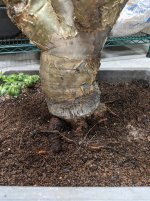
@JoeWilson, your observations of the inverse taper and weak Nebari on Bursera fagaroides and Operculicarya decaryi is correct. This is a multifactorial issue and not necessarily a fault of the species in question. Most growers of these species are succulent & cactus collectors, which means they typically are not selecting seedlings and genetics for the same reasons that you and I are. Most of the succulent & cactus community are interested in how rare or unique the genetics are, rather than what we Bonsai collectors are interested in (small foliage, good taper, flaring nebari, aged bark, ramification, etc.). This is not a value judgement by any means, but it helps understand why major structural issues (by Bonsai standards) go unaddressed with most trees that fall into the pachyform or caudiciform camps. There are almost no growers of caudiciforms or pachyforms that approach their cultivation from a Bonsai-centric standpoint (especially early in development).

With all of that out of the way, there are several ways to skin this cat.

1.) Select trees early (seedling age) and only work with ones that display no inverse taper and flat root structures. Then build a quality specimen from that material over the next 15-20 years.
2.) Take root cuttings, air-layers, ground-layers and large diameter cuttings and rebuild build good nebari and taper from there. One big note, Bursera can be propagated from the following methods: seeds, cutting (big ones too), air-layer and ground-layer). This NOT the case for Operculicarya decaryi. Operculicarya decaryi are most easily propagated from: seed, root-cutting, air-layer & ground-layer (they almost never propagate from standard cuttings). With Bursera fagaroides I like working from large diameter cuttings (4"+ diameter) or air-layers. With Operculicarya decaryi, I prefer air-layering when trying to correct for bad taper and roots.
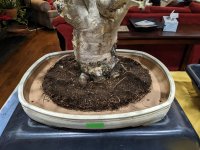
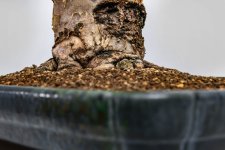
3.) Plant in shallow containers and regularly repot and root prune to encourage surface roots. Using a good top-dressing of shredded sphagnum moss helps keep the surface roots moist until they are big enough to bark-up and not desiccate away via air-pruning.
4.) Planting in a quality Bonsai mix like Aoki Blend, Clay King, or some other volcanic mix will ensure you have the best chance at getting quality root production. Using other, excessively organic, mixes will cause root death and encourage the tree to store water in the trunk and storage roots resulting in that inverse taper we are trying to avoid. Additionally, people tend to grossly underwater their Bursera fagaroides and Operculicarya decaryi (avoiding root rot due to bad organic soil) which results in root desiccation and then the tree starts storing water in the trunk and gall-like storage roots all over again (they look like carrots or peanuts).

So, nothing mind blowing here. All the aforementioned techniques have been around for a long time and are very commonly used when cultivating deciduous Bonsai. There are just subtle differences and timing adjustments that need to be considered. I hope that this was of some help. I have attached a pile of photos to help illustrate some of the techniques that I touched upon in this post. Down the road I will start a tread on Operculicarya decaryi in Bonsai-culture. I'll share it with you when I get it launched. Cheers!

Bursera fagaroides_Air-Layer_01.jpgBursera fagaroides_Air-Layer_02.jpgBursera fagaroides_Air-Layer_03.jpgOperculicarya decaryi_Nebari_Root Cutting.jpgGordita_Nebari_01.jpgGordita_Nebari_02.jpgGordita_Nebari_03.jpgGordita_Nebari_04.jpg
 
@JoeWilson, your observations of the inverse taper and weak Nebari on Bursera fagaroides and Operculicarya decaryi is correct. This is a multifactorial issue and not necessarily a fault of the species in question. Most growers of these species are succulent & cactus collectors, which means they typically are not selecting seedlings and genetics for the same reasons that you and I are. Most of the succulent & cactus community are interested in how rare or unique the genetics are, rather than what we Bonsai collectors are interested in (small foliage, good taper, flaring nebari, aged bark, ramification, etc.). This is not a value judgement by any means, but it helps understand why major structural issues (by Bonsai standards) go unaddressed with most trees that fall into the pachyform or caudiciform camps. There are almost no growers of caudiciforms or pachyforms that approach their cultivation from a Bonsai-centric standpoint (especially early in development).

With all of that out of the way, there are several ways to skin this cat.

1.) Select trees early (seedling age) and only work with ones that display no inverse taper and flat root structures. Then build a quality specimen from that material over the next 15-20 years.
2.) Take root cuttings, air-layers, ground-layers and large diameter cuttings and rebuild build good nebari and taper from there. One big note, Bursera can be propagated from the following methods: seeds, cutting (big ones too), air-layer and ground-layer). This NOT the case for Operculicarya decaryi. Operculicarya decaryi are most easily propagated from: seed, root-cutting, air-layer & ground-layer (they almost never propagate from standard cuttings). With Bursera fagaroides I like working from large diameter cuttings (4"+ diameter) or air-layers. With Operculicarya decaryi, I prefer air-layering when trying to correct for bad taper and roots.
3.) Plant in shallow containers and regularly repot and root prune to encourage surface roots. Using a good top-dressing of shredded sphagnum moss helps keep the surface roots moist until they are big enough to bark-up and not desiccate away via air-pruning.
4.) Planting in a quality Bonsai mix like Aoki Blend, Clay King, or some other volcanic mix will ensure you have the best chance at getting quality root production. Using other, excessively organic, mixes will cause root death and encourage the tree to store water in the trunk and storage roots resulting in that inverse taper we are trying to avoid. Additionally, people tend to grossly underwater their Bursera fagaroides and Operculicarya decaryi (avoiding root rot due to bad organic soil) which results in root desiccation and then the tree starts storing water in the trunk and gall-like storage roots all over again (they look like carrots or peanuts).

So, nothing mind blowing here. All the aforementioned techniques have been around for a long time and are very commonly used when cultivating deciduous Bonsai. There are just subtle differences and timing adjustments that need to be considered. I hope that this was of some help. I have attached a pile of photos to help illustrate some of the techniques that I touched upon in this post. Down the road I will start a tread on Operculicarya decaryi in Bonsai-culture. I'll share it with you when I get it launched. Cheers!

View attachment 609119View attachment 609120View attachment 609121View attachment 609122View attachment 609123View attachment 609124View attachment 609125View attachment 609126

Thanks, that was very helpful!

My wife grows succulents, but not the caudex type, so it's a bit of a blind spot for both of us. This matches my impression, though, that succulent growers generally want an engorged caudex. I've read that growing in a very small pot can encourage that, and too little watering makes sense, too. I assume that if it's rootbound and not getting enough water, that tells it to go into conservation mode and fatten up. So I suppose doing the opposite should be a good way to keep it proportional.

Air layering makes a lot of sense. I can see how you would be able to get nice radial roots that way. I'll keep that in mind if I can't get the roots in check. The few Operculicarya decaryi I ordered had very carrot-like root systems where the caudex tapers down, and there's a tap root with some feeder roots below that. I'm hoping I can develop some radial roots and start to trim the tap root back, but we'll see.

I've got a 5-part mix that was recommended to me by someone on the Rocky Mountain Bonsai Society that I use for my cold-hardy plants: potting soil, akadama, coco coir, lava, and pumice. Do you think that would be a good choice for these guys, or should I opt for less organic material (maybe drop the coir?). Currently, I have them in LGM cactus/succulent soil. I'm not sure what the mix is here, but it probably has a higher organic content than you're suggesting, so I'll plan on getting it into something else for sure.

I'm going down the rabbit hole here with succulent trees, trying to find interesting arid-climate species that I can grow indoors (I have a grow light setup, which I hope is powerful enough). So I would love to see more info/posts like this. Some of the other species I'm trying out are Commiphora (myrrh), Euphorbia misera (cliff spurge), Fouquieria, and Brachychiton bidwillii (Kurrajong), along with the usual suspects (ficus, jade, and umbrella tree). I will probably get a Boswellia too. If you have opinions on any of these or suggestions for other weird caudex guys to try out, please let me know.
 
Thanks, that was very helpful!

My wife grows succulents, but not the caudex type, so it's a bit of a blind spot for both of us. This matches my impression, though, that succulent growers generally want an engorged caudex. I've read that growing in a very small pot can encourage that, and too little watering makes sense, too. I assume that if it's rootbound and not getting enough water, that tells it to go into conservation mode and fatten up. So I suppose doing the opposite should be a good way to keep it proportional.

Air layering makes a lot of sense. I can see how you would be able to get nice radial roots that way. I'll keep that in mind if I can't get the roots in check. The few Operculicarya decaryi I ordered had very carrot-like root systems where the caudex tapers down, and there's a tap root with some feeder roots below that. I'm hoping I can develop some radial roots and start to trim the tap root back, but we'll see.

I've got a 5-part mix that was recommended to me by someone on the Rocky Mountain Bonsai Society that I use for my cold-hardy plants: potting soil, akadama, coco coir, lava, and pumice. Do you think that would be a good choice for these guys, or should I opt for less organic material (maybe drop the coir?). Currently, I have them in LGM cactus/succulent soil. I'm not sure what the mix is here, but it probably has a higher organic content than you're suggesting, so I'll plan on getting it into something else for sure.

I'm going down the rabbit hole here with succulent trees, trying to find interesting arid-climate species that I can grow indoors (I have a grow light setup, which I hope is powerful enough). So I would love to see more info/posts like this. Some of the other species I'm trying out are Commiphora (myrrh), Euphorbia misera (cliff spurge), Fouquieria, and Brachychiton bidwillii (Kurrajong), along with the usual suspects (ficus, jade, and umbrella tree). I will probably get a Boswellia too. If you have opinions on any of these or suggestions for other weird caudex guys to try out, please let me know.
@JoeWilson, I would drop the coco coir. I avoid any organics as it really help mitigate overwatering. All the tips and tricks I have been talking about in this Bursera fagaroides thread will map over to almost all of the Burseraceae family of plants. In fact, in my practice most caudiciforms and pachyforms seem to respond very similarly to the techniques that I apply to Bursera fagaroides. True topicals like ficus, buttonwood, bougainvillea, umbrella trees, etc. are a whole different animal and this thread will be of little help there (I do not have any good first hand experience with any of those species).

I do have a Brachychiton rupestris (Queensland Bottle Tree) that I have been growing since 2012 and just cut back hard to build better taper and compressed apex. See photos below of the work I did about a week ago (NOTE: the pot is about 17" wide for reference). Cheers!
 

Attachments

  • Brachychiton rupestris_After.jpg
    Brachychiton rupestris_After.jpg
    247.7 KB · Views: 48
  • Brachychiton rupestris_Before.jpg
    Brachychiton rupestris_Before.jpg
    314.3 KB · Views: 57
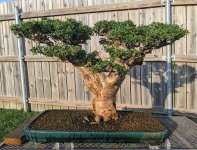
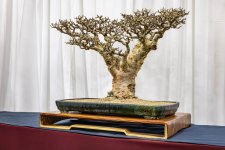
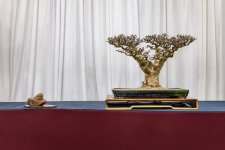
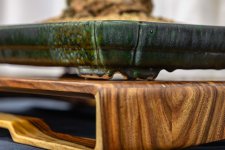
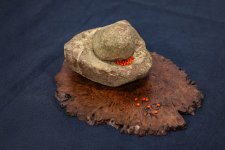
Here is an Instagram post I published yesterday documenting my Bursera fagaroides Bonsai display submission to the 2025 9th U.S. National Bonsai Exhibition in Rochester, NY. This is the first time a Bursera has been accepted to the show and it is the first time a desert theme was accepted. It is an 'All American' display (Tree, Pot & Stand all USA).

To learn more about the display, follow the IG link and read the write-up. It has been an 18 year journey for me to get this tree to a level that would be accepted to the Nationals.

...

Also, attached are photos from the display for the forum community to enjoy. Cheers!
 

Attachments

  • CH2_3931.JPG
    CH2_3931.JPG
    335.7 KB · Views: 33
  • CH2_3945.JPG
    CH2_3945.JPG
    226.5 KB · Views: 27
  • CH2_3939.JPG
    CH2_3939.JPG
    362.2 KB · Views: 27
  • CH2_3937.JPG
    CH2_3937.JPG
    297.2 KB · Views: 23
  • CH2_3951.JPG
    CH2_3951.JPG
    409.8 KB · Views: 25
  • CH2_3923.JPG
    CH2_3923.JPG
    300.7 KB · Views: 24
  • CH2_4217.JPG
    CH2_4217.JPG
    271 KB · Views: 22
  • CH2_3925.JPG
    CH2_3925.JPG
    248.7 KB · Views: 27
@Kurt Dillow Don’t know where you’re based out of, but if you’re ever in the Fallbrook area, you should definitely check out Gavilan Mountain Succulents.


His name is Steven Dewey and his son also grows/sells at the property too. Biggest decaryi that I’ve ever seen. Don’t know if any of his specimen pachypus are for sale (as they were given to him because they were collected), but he’s got a vast inventory of thick 6-inch potted pachypus. His son has a lot of 3.5in seedlings for sale as well. Very nice guy. Just an amazing place to walk through as well. There’s also Botanic wonders nearby, Petra at RareSucculents, and Jim and Philippe at Sherman Nursery/Extraordinary Plants as well.

I’ve been seeing your Bursera and Operculicaryas pop up on Instagram and man they are so good.
 
@Kurt Dillow Don’t know where you’re based out of, but if you’re ever in the Fallbrook area, you should definitely check out Gavilan Mountain Succulents.


His name is Steven Dewey and his son also grows/sells at the property too. Biggest decaryi that I’ve ever seen. Don’t know if any of his specimen pachypus are for sale (as they were given to him because they were collected), but he’s got a vast inventory of thick 6-inch potted pachypus. His son has a lot of 3.5in seedlings for sale as well. Very nice guy. Just an amazing place to walk through as well. There’s also Botanic wonders nearby, Petra at RareSucculents, and Jim and Philippe at Sherman Nursery/Extraordinary Plants as well.

I’ve been seeing your Bursera and Operculicaryas pop up on Instagram and man they are so good.

@800dbcloud, thank you very much for sharing those leads. Funny you should mention all of them. I have been on and off chatting with Steven Dewey for about 2 years now, as I am trying to find a nice pachypus specimen for Bonsai. I have been DM chatting with Botanic Wonders as well for the last 6 months (great people as well). The other tow leads I have not yet contacted, so thank you very much. I really appreciate the leads.

I am in Missouri, so kind far away from them, but that is normal for me :). Thank you for the kind words regarding my Xeric trees. I have been trying to get them to a higher standard to build better awareness, outside of the xeric community, so people start adopting them more in Bonsai culture. Just my little pipe-dream. Cheers!
 
Hello!
This thread is great, thanks a lot!
I grew my Bursera Fagaroides from a seed. It is 16-17 years old. It is currently in a 3-liter pot and has a trunk about 35 cm high. It grows rather quickly but never blooms. What conditions does it need to bloom?
 
Hopefully I'll get around to posting my B Fagaroides and B microphylla. Still in 3 gal pots how I got them. Life has really thrown me a curve ball. However, along with their use as bonsai (how I first discovered them) I am super interested in the Mesoamerican use of the Copal tree. (Fagaroides). Microphylla is actually native to where I live. Not common by any means but they do grow here in very specific areas. I am going to come back here and study propagation and wound care and get some pointers on directions to take with mine. Both super healthy.
 
Hello!
This thread is great, thanks a lot!
I grew my Bursera Fagaroides from a seed. It is 16-17 years old. It is currently in a 3-liter pot and has a trunk about 35 cm high. It grows rather quickly but never blooms. What conditions does it need to bloom?
@Yenisei, very cool. Welcome to the thread. Feel free to share pics and any interesting experiences you have had with the species.
 
Last edited:
Very cool. Welcome to the thread. Feel free to share pics and any interesting experiences you have had with the species.
LOL well my best experience thus far is that they have thrived on my neglect! I'm a huge fan however. As others have said that smell from B Fagaroides is intoxicating! I've basically been able to keep them thriving for going on three years of Phoenix weather by mainly just watering once in a while.
 
Hopefully I'll get around to posting my B Fagaroides and B microphylla. Still in 3 gal pots how I got them. Life has really thrown me a curve ball. However, along with their use as bonsai (how I first discovered them) I am super interested in the Mesoamerican use of the Copal tree. (Fagaroides). Microphylla is actually native to where I live. Not common by any means but they do grow here in very specific areas. I am going to come back here and study propagation and wound care and get some pointers on directions to take with mine. Both super healthy.
@milehigh_7, very cool. Definitely share pics of you trees. If you ever run into them in habitat where you live, please take photos of the specimens and surroundings. I love working on refining "desert display" aesthetics, so the more visual data that can be gathered the better. Plus the community can see what their raw/wild growth habits look like.
 
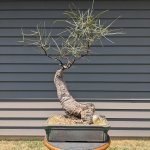
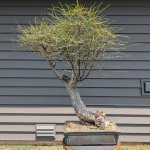
Here's my two. You can see that reverse taper on the Fagaroides that I guess I'm either going to have to do a cutting from the whole top or layer the whole top off to fix. The second pic is another cool tree called a Pachycormus discolor. It's got about a about 1.5" trunk.


1764555677985.png


1764555943880.png
 
@milehigh_7, thank you for sharing the photos. I have done both cutting and air-layering to address reverse taper issues with Bursera in my collection. So I would say wither direction would be no problem. I would hold until the next growing season kicks off as I have had a lot more success when they are able to heal rapidly. I love Pachycormus discolor, thank you for sharing a pic of yours.
 
Back
Top Bottom