Thank God I Used Wire!!!

Tidal Bonsai

Omono
Messages
1,675
Reaction score
4,265
Location
Brick NJ (USA)
USDA Zone
7a
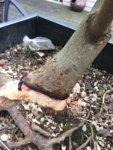
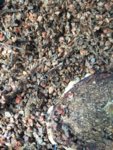
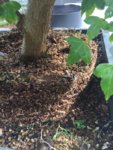
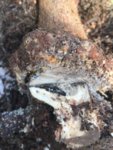
I just checked on my Trident Maple trunk layer that I made about 2.5 weeks ago. There is a single root (yay!!!), but the callus seems like its rolling over the wire. Do you think the wire I wrapped around it will stop it from sealing, or should I cut the callus and use a bigger wire?
 

Attachments

  • IMG_3480.JPG
    IMG_3480.JPG
    366.8 KB · Views: 148
  • IMG_3482.JPG
    IMG_3482.JPG
    447.9 KB · Views: 149
  • IMG_3657.JPG
    IMG_3657.JPG
    477.2 KB · Views: 138
  • IMG_3658.JPG
    IMG_3658.JPG
    509 KB · Views: 140
I would have removed a strip of cambium at least twice as wide as the one you did... a healthy trident can bridge smaller gaps and the layer will fail. If this were my layer, I'd gently pull the soil away from the trunk and remove more cambium... honestly not sure what to do about the wire as I've never used one on a layer... I'd probably leave it be since you are getting roots to grow.
 
I just checked on my Trident Maple trunk layer that I made about 2.5 weeks ago. There is a single root (yay!!!), but the callus seems like its rolling over the wire. Do you think the wire I wrapped around it will stop it from sealing, or should I cut the callus and use a bigger wire?
That is going to be a nice one!
 
I just checked on my Trident Maple trunk layer that I made about 2.5 weeks ago. There is a single root (yay!!!), but the callus seems like its rolling over the wire. Do you think the wire I wrapped around it will stop it from sealing, or should I cut the callus and use a bigger wire?
I vote bigger wire. You can always ask smoke. Lol
 
I'd gently pull the soil away from the trunk and remove more cambium... honestly not sure what to do about the wire as I've never used one on a layer... I'd probably leave it be since you are getting roots to grow.

The wire is to prevent it from rolling and healing itself without having to remove a larger strip of cambium (and loosing more taper). This is the first time I have tried it as well, I will use a bigger wire next time!
 
The wire is to prevent it from rolling and healing itself without having to remove a larger strip of cambium (and loosing more taper). This is the first time I have tried it as well, I will use a bigger wire next time!
I understand the function of the wire here, but would leave it as is because you don't want to damage any developing roots. You can widen the strip of excised cambium at the root base and not lose any taper.
 
I've done a few layers where I've used a wire like this (I usually don't bother with a wire) and honestly, it's never seemed to really work as intended. The trees have still managed to push callus past the wire. Maybe that means I haven't applied it tight enough? Anyway, I've been battling a similar situation with an attempted ground layer on a maple, for a couple of years. Each season I've had to recut the layering site because the callus just grows right past it and roots don't form. I don't really have room to extend the cut further down so I just keep trying. This year I added a stronger rooting hormone gel so fingers crossed.

 
I've done a few layers where I've used a wire like this (I usually don't bother with a wire) and honestly, it's never seemed to really work as intended. The trees have still managed to push callus past the wire. Maybe that means I haven't applied it tight enough? Anyway, I've been battling a similar situation with an attempted ground layer on a maple, for a couple of years. Each season I've had to recut the layering site because the callus just grows right past it and roots don't form. I don't really have room to extend the cut further down so I just keep trying. This year I added a stronger rooting hormone gel so fingers crossed.
I've had that too. I just recut and leave it exposed to the air for a couple days. Then re wrap and 99 percent of the time it issues roots. If it don't I usually just get frustrated and kick the shit out of it. Then the next day I go out and give the whole thing a proper burial and never talk about it again. If I'm lucky the damn thing will start growing again from the burial site and a better tree develops over the next several years. Your the only one that knows this trick though. Don't tell anyone.
 
I've had that too. I just recut and leave it exposed to the air for a couple days. Then re wrap and 99 percent of the time it issues roots. If it don't I usually just get frustrated and kick the shit out of it. Then the next day I go out and give the whole thing a proper burial and never talk about it again. If I'm lucky the damn thing will start growing again from the burial site and a better tree develops over the next several years. Your the only one that knows this trick though. Don't tell anyone.

I've never considered that approach. This spring I gave up on another maple ground layer that wasn't working and just planted it in the ground to enjoy there (it wasn't ever going to be a worthwhile bonsai anyway, just another project I should have moved on from a couple of years ago). But that other one, hmmm....maybe just threatening it will work.
 
I've never considered that approach. This spring I gave up on another maple ground layer that wasn't working and just planted it in the ground to enjoy there (it wasn't ever going to be a worthwhile bonsai anyway, just another project I should have moved on from a couple of years ago). But that other one, hmmm....maybe just threatening it will work.
No..threatening is not the answer. Boot prints is. You have to literally give up on it and kick it out of your life. Thats the way life works. No mercy. You will be rewarded.
 
When I checked the layer today, it was filled with roots, so I began to separate it.
 

Attachments

  • IMG_4216.JPG
    IMG_4216.JPG
    383.2 KB · Views: 47
  • IMG_4218.JPG
    IMG_4218.JPG
    445.5 KB · Views: 51
After digging it all out, I was disheartened to find out that all of those roots were from only 1/4 of the trunk (luckily it was from the trees tenative front). I had no idea why no new roots would be issued from the other 3/4 of the trunk until I started sawing...
 

Attachments

  • IMG_4220.JPG
    IMG_4220.JPG
    452 KB · Views: 51
  • IMG_4221.JPG
    IMG_4221.JPG
    432.5 KB · Views: 55
When I started sawing off the bottom of the layer, I kept hitting something hard, and metal. I had no idea what the f%^* it was. I had to keep changing angles, and sawing harder and harder until I found out what it was...a metal washer completely imbedded in the trunk of the tree.

Whoever prepared this stock never removed the washer that seedlings are grown in to get flaring bases. All of these years later, it was completely imbedded and seeming to prevent sap flow and roots to the opposite side of the tree. I applied more rooting hormone and am optomistic that I will have a nice raidial root system by the Spring. I used Al's tip/trick of using the bottom of the container to flatten the roots out.

It was lightly hedge pruned and moved to partial shade until the new roots strengthen.
 

Attachments

  • IMG_4222.JPG
    IMG_4222.JPG
    289.4 KB · Views: 53
  • IMG_4223.JPG
    IMG_4223.JPG
    409.9 KB · Views: 52
I don't think the issue here was wire thickness or even the use of it. I don't even believe entirely in wire for layers. I don't use it myself and pretty much have about 98% success rate with air layering maples. Most of the issue here is how deep and how wide the cut was made as already mentioned by Dav4. Trees are highly opportunistic and they will resort to the path of least resistance. Hence they will bridge if given the slightest chance and the layer attempt will fail.
 
Back
Top Bottom