Pitch pine advice

jackstraw

Seedling
Messages
6
Reaction score
2
Location
Asheville, NC
USDA Zone
7a
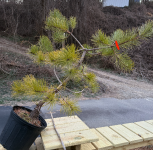
I'm looking for some styling advice for this pitch pine, and I have some general questions about pinus rigida.
First, some general information about this specific tree: pinus rigida "wintertime." It stands about 4 feet tall. I generally like taller trees, so I'm happy with the height. The top was removed from the tree right before I got it, I think it was about a foot that was removed. I'm currently in the middle of winter, zone 7a, Asheville, NC.
In the first image I've circled a lower branch that I'm considering removing. What's the best way to remove this branch without stressing the tree too much? Is it okay to just remove it in the dead of winter? Would it be more beneficial for the health of the tree to put a black bag over this branch in the spring, and let it slowly die, so the tree "absorbs" that energy and pushes it elsewhere into the tree?
Another general question about pines: at what point should I be concerned about the whorls? Should I be looking to remove all but one branch at each whirl? Is it too much removal from the tree to do that all in one season?
The second image is close to the apex of the tree. The branch that is circled I plan on wiring up a bit, and making the new apex, following the natural movement of the tree. In the third image you can see what I'm talking about a little bit better, and I've also marked where I plan on cutting the right branch back.
Here's the kicker, it also needs to be repotted. I have some grow boxes that are about 14x14x4" and I was hoping to get the tree in one of those. I would be waiting until spring to repot, but my concern is am I trying to accomplish too much in a year? The third image is also the angle I'm going for when I repot.
Any and all advice is welcome.
 

Attachments

  • Pine 1.png
    Pine 1.png
    1.7 MB · Views: 76
  • Pine 2.png
    Pine 2.png
    1.2 MB · Views: 72
  • Pine 3.png
    Pine 3.png
    1 MB · Views: 75
I'm looking for some styling advice for this pitch pine, and I have some general questions about pinus rigida.
First, some general information about this specific tree: pinus rigida "wintertime." It stands about 4 feet tall. I generally like taller trees, so I'm happy with the height. The top was removed from the tree right before I got it, I think it was about a foot that was removed. I'm currently in the middle of winter, zone 7a, Asheville, NC.
In the first image I've circled a lower branch that I'm considering removing. What's the best way to remove this branch without stressing the tree too much? Is it okay to just remove it in the dead of winter? Would it be more beneficial for the health of the tree to put a black bag over this branch in the spring, and let it slowly die, so the tree "absorbs" that energy and pushes it elsewhere into the tree?
Another general question about pines: at what point should I be concerned about the whorls? Should I be looking to remove all but one branch at each whirl? Is it too much removal from the tree to do that all in one season?
The second image is close to the apex of the tree. The branch that is circled I plan on wiring up a bit, and making the new apex, following the natural movement of the tree. In the third image you can see what I'm talking about a little bit better, and I've also marked where I plan on cutting the right branch back.
Here's the kicker, it also needs to be repotted. I have some grow boxes that are about 14x14x4" and I was hoping to get the tree in one of those. I would be waiting until spring to repot, but my concern is am I trying to accomplish too much in a year? The third image is also the angle I'm going for when I repot.
Any and all advice is welcome.
Great start! If your tree is due for repotting, I would plan on getting that taken care of first. Get the roots teased out, and into a good medium with drainage/aeration.

The whorls will eventually be a problem, but I wouldn't stress too much about them at this stage. Pines grow/thicken slow, so they won't be an issue this season. That being said, you can remove anything you decide you do not need right now with no issue.
 
Great start! If your tree is due for repotting, I would plan on getting that taken care of first. Get the roots teased out, and into a good medium with drainage/aeration.

The whorls will eventually be a problem, but I wouldn't stress too much about them at this stage. Pines grow/thicken slow, so they won't be an issue this season. That being said, you can remove anything you decide you do not need right now with no issue.
Ok great, I appreciate it. I guess my main concern was removing too much during winter. Maybe I'll just start with that longer, lower branch and repot in the spring. I'll make decisions on other branches to remove as I get new growth.
 
While I agree repotting should come first, so you know what you're left with - if anything, repotting can be challenging. I want to sow the seed of the idea to build the tree up from the lowest branch.
Here's my thoughts: The straight part above the first set of branches will hardly develop any taper unless the branches above it are allowed to run, like seriously run free. As in a couple feet of length. Imagine how wide the base would be if you envision a bonsai tree with that height, in width-to-height and top-to-bottom a ratio that works for you.
That can mean that you're looking at a straight pole for the next five to ten years. And also that you kind of can't really start a final design until you're close to that point. Working that back into a more compacted design is difficult.

If you instead hack back to that first set of branches, and develop those, the taper will be there faster, as you're not aiming to overcome about a feet or two of wood needing to thicken; you'd just need the lower branches to catch up to what's already below there; and that part is already pretty tapered on its own. If the branches you hack back to, gain two feet, they're more or less at the point where the branches you want to keep are now. The benefit of this approach is that you can work the side branches already and you can start styling in a way earlier time, because you can put movement in that branch-become-trunk immediately. This in turn can give you more design freedom and more silly-putty than trying to bend an almost inch-thick straight rod.
I'm not saying you should, but please consider this approach.
Your initial approach would become more of an engineering challenge (how do you bend a straight piece of wood? How much rebar can a pot hold before it topples over? What size wire can hold thick wood?) and the approach I'm advocating would be more of a 'wire and see where it grows' kind of thing. Neither are wrong, both are challenging, but I personally take more pleasure out of rebuilding compared to engineering. Because simply put, the engineering lets me do one thing a year, maybe two, and the rebuilding allows me to work the plant every season. The road can be equally long for sure, but I find the rebuilding route more rewarding on the short term.
If those lower branches are removed, you eliminate the option to rebuild for a large part.

exmple.jpg
 
While I agree repotting should come first, so you know what you're left with - if anything, repotting can be challenging. I want to sow the seed of the idea to build the tree up from the lowest branch.
Here's my thoughts: The straight part above the first set of branches will hardly develop any taper unless the branches above it are allowed to run, like seriously run free. As in a couple feet of length. Imagine how wide the base would be if you envision a bonsai tree with that height, in width-to-height and top-to-bottom a ratio that works for you.
That can mean that you're looking at a straight pole for the next five to ten years. And also that you kind of can't really start a final design until you're close to that point. Working that back into a more compacted design is difficult.

If you instead hack back to that first set of branches, and develop those, the taper will be there faster, as you're not aiming to overcome about a feet or two of wood needing to thicken; you'd just need the lower branches to catch up to what's already below there; and that part is already pretty tapered on its own. If the branches you hack back to, gain two feet, they're more or less at the point where the branches you want to keep are now. The benefit of this approach is that you can work the side branches already and you can start styling in a way earlier time, because you can put movement in that branch-become-trunk immediately. This in turn can give you more design freedom and more silly-putty than trying to bend an almost inch-thick straight rod.
I'm not saying you should, but please consider this approach.
Your initial approach would become more of an engineering challenge (how do you bend a straight piece of wood? How much rebar can a pot hold before it topples over? What size wire can hold thick wood?) and the approach I'm advocating would be more of a 'wire and see where it grows' kind of thing. Neither are wrong, both are challenging, but I personally take more pleasure out of rebuilding compared to engineering. Because simply put, the engineering lets me do one thing a year, maybe two, and the rebuilding allows me to work the plant every season. The road can be equally long for sure, but I find the rebuilding route more rewarding on the short term.
If those lower branches are removed, you eliminate the option to rebuild for a large part.

View attachment 626476
I absolutely appreciate your input. I guess I hadn't considered chopping that low. Am I good to remove that much at once? And I'm guessing that needs to be done late winter?
I'm definitely going to repot this year, and will make a decision on styling, and where I want to cut, throughout the year. I'll save that work for later.
 
Mid or late winter should be fine for these kind of things. If you go for the chop down low, please leave a stub, preferably a longer one. You can put screws in there, and bowstring the whole tree into shape with one or two guy-wires.
I did a couple designs on similar material in terms of taper, with a clean straight cut, and it's not healing the way I hoped - and my bark-grafts failed. So now the wound will look manmade for a long time.

Repotting first, because the plant might decide to drop branches as a result and that could mean you'd need to re-assess the design options.
 
Mid or late winter should be fine for these kind of things. If you go for the chop down low, please leave a stub, preferably a longer one. You can put screws in there, and bowstring the whole tree into shape with one or two guy-wires.
I did a couple designs on similar material in terms of taper, with a clean straight cut, and it's not healing the way I hoped - and my bark-grafts failed. So now the wound will look manmade for a long time.

Repotting first, because the plant might decide to drop branches as a result and that could mean you'd need to re-assess the design options.
Sweet. I appreciate it!
 
I’m always struck by the color variation in pitch pine needles. Around me they’re a very dark green, but I see trees from other regions with yellowish or even outright yellow needles. I’m sure part of it is nutrient related but I can’t help but wonder if there’s regional variation too.

I don’t have anything helpful to offer but that observation 😂
 
Also remember that Pitch Pines will bud back along the trunk when cut back hard, sometime too much even on very old wood.
So it is possible to end up with branches in places where you don't have any now.
The first one I collected about 80 yrs old, mid April a long time ago, lost every single needle on the tree. I thought it was gone but then a few weeks later all brand new candles started to open.
As far as color that few that I have seem to vary in color from yellowish to light green, all in the same mix and treated the same.
Hard to tell the diameter of the trunk but I have one that was tall ~ 4 feet and around 2 inches where I bent it down in a upside down U by wrapping with Raffia and Heavy wire then pulled it down and together using wire between with a turnbuckle that I tightened over weeks and months.
 
I’m always struck by the color variation in pitch pine needles. Around me they’re a very dark green, but I see trees from other regions with yellowish or even outright yellow needles. I’m sure part of it is nutrient related but I can’t help but wonder if there’s regional variation too.

I don’t have anything helpful to offer but that observation 😂
😂 I know this is a “wintertime” cultivar. I’m sure that has to do with the color variation, too.
 
Also remember that Pitch Pines will bud back along the trunk when cut back hard, sometime too much even on very old wood.
So it is possible to end up with branches in places where you don't have any now.
The first one I collected about 80 yrs old, mid April a long time ago, lost every single needle on the tree. I thought it was gone but then a few weeks later all brand new candles started to open.
As far as color that few that I have seem to vary in color from yellowish to light green, all in the same mix and treated the same.
Hard to tell the diameter of the trunk but I have one that was tall ~ 4 feet and around 2 inches where I bent it down in a upside down U by wrapping with Raffia and Heavy wire then pulled it down and together using wire between with a turnbuckle that I tightened over weeks and months.
This one is about 3” across at the base of the trunk. I’m still undecided if I want to hard chop or not. I have to repot this spring. I reckon I’ll see how the tree responds, then decide on how to proceed with styling going into next year
 
I would follow Tidal's advice on repotting first, then I would wait a year for tree to recover before deciding on removals.

I also saw the same trunk line which wiresguywires saw, though if you wanted a taller tree, that is possible as well with wiring.

I wouldnt cut back anything now.
 
Back
Top Bottom