Overwintering in zone 6b (Massachussetts) - my solution for building a greenhouse

harshadg

Yamadori
Messages
92
Reaction score
193
Location
Massachussetts
USDA Zone
6b
I moved to Massachusetts this August, and this is my first winter here. In my previous location I overwintered everything in an attached garage — stable temps, minimal swings, essentially a cold room with no surprises.

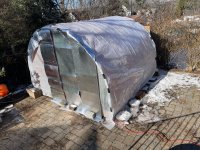
Here, the only usable spot is a section of pavers in the backyard. No garage. No enclosed shed. So I bought a 10' x 10' greenhouse/polytunnel thinking it would be good enough for a typical New England winter.

Short answer: it wasn’t.
Long answer: here’s everything I ended up doing, and what actually worked — with real temperature data.

1. First Attempt: Polytunnel + Sensors = Basically a Windbreak

I put the trees inside the polytunnel and added Govee sensors to monitor temps. Very quickly I learned that a single-layer polytunnel barely holds any heat. It cut the wind, sure (and this was critical when we had 38 mph winds recently), but inside temperatures were only 1–2°F above ambient. This wasn't going to work for truly cold nights that were anticipated.

On top of that, here in MA we've seen some awfully cold temps with dips into the single digits. With nowhere else to store them I had to adapt quickly.

2. Insulation Overhaul (Double Wall, Bubblewrap, Foamular)

I upgraded the structure with:
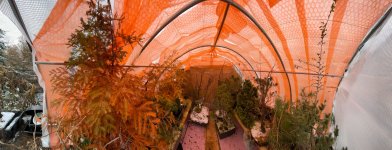
  • Double polyethylene skin
  • Interior bubblewrap layer
  • Foamular boards along the cold walls and base
  • Corrugated cardboard to fill in the gaps
Currently the order is: Outside>6 mil PE sheet>6mil PE sheet> bubblewrap>inside but the better strategy for next year is: Outside>6 mil PE sheet>bubblewrap>6 mil PE sheet>inside).

This improved nighttime performance but created two opposing issues:
  1. Daytime overheating — even on 40°F days, interior temps shot into the upper 60s or low 70s.
  2. Nighttime heat loss still too steep — not enough buffer for nights in the teens.
So I needed a way to flatten both ends of the temperature curve.

3. Controlling Solar Gain: Shade Cloth + Reflective Bubblewrap

To tackle the daytime spikes, I added:
  • 50% shade cloth over the top of the polytunnel, and
  • Reflective bubblewrap across the south-facing front section
This combination cut enough direct sunlight to stop the runaway midday heat while still allowing the structure to warm gently. After adding these, daytime temperatures stopped hitting 70°F and held in a much safer range < 50°F (closer to 40°F).

With predicted temps dropping to 6°F earlier this week, I needed to rapidly work on a solution for the nighttime lows.

4. Heater + Thermostat: ITC-608T + 900W Ceramic Heater

I installed a 900W heater (max 1500 W, with tip-over protection) controlled by an Inkbird ITC-608T thermostat. This finally gave me:
  • A stable nighttime minimum, and
  • Automatic cutoff to prevent overheating
Simultaneously, working on insulating the gaps (between the doors and the rest of the paneling for example) really helped with keeping warm air in the greenhouse.

5. My Phone Wasn’t Logging Sensor Data Unless I Was Near Them

Next, I needed to tackle the issue of realtime monitoring. My Govee sensors are bluetooth beacons and to gather the data my phone needs to be in proximity (10-15 ft). That meant I needed to go out in the biting cold to sync my phone to the devices. It get's a bit annoying and I don't particularly enjoy the cold, so I built my own solution that allows me to collect the data while staying indoors.

6. I Wrote an App to Pull, Store, and Visualize All Sensor Data

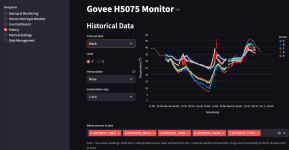
To fix the logging problem, I wrote a small app that I can deploy on my computer that continuously syncs and plots data from multiple Govee H5075 sensors. Right now I’m running five sensors, each in a different microclimate:
  1. Greenhouse interior
  2. Three-season porch (attached to house, partial buffer zone)
  3. West wall (sun-exposed side)
  4. North wall (near furnace exhaust; surprisingly warm niche)
  5. True ambient control (open yard)
Further, I can gather data from the closest weather station too and overlay it alongside readings from my garden.

7. This weeks Freeze (predicted 7°F Outside overnight): Actual Temperature Performance

Here’s what the sensors recorded:
  • Outdoor ambient (control): 10°F
  • Greenhouse interior: ~25°F
  • Three-season porch: ~25°F
  • West wall (air-exposed): ~15°F
  • North wall (air-exposed): ~15°F
So far so good. I’ll keep collecting data this winter and refining the setup, but so far this combination has made it workable even with single digit lows. If anyone wants details on the sensor layout, the app, or the insulation approach, I’m happy to share more.

Stay warm!
 

Attachments

  • IMG_6826.jpg
    IMG_6826.jpg
    633.9 KB · Views: 27
  • Screenshot 2025-12-10 at 6.52.01 pm.png
    Screenshot 2025-12-10 at 6.52.01 pm.png
    354.4 KB · Views: 26
  • IMG_6823.jpg
    IMG_6823.jpg
    472.2 KB · Views: 27
To fix the logging problem, I wrote a small app that I can deploy on my computer that continuously syncs and plots data from multiple Govee H5075 sensors.
That is awesome! I have the 5179 sensors and have the 1min data archive to my email monthly. But I know the pain of having to stand outside in the cold to sync the data from the coldframes. Most of the time I can get them to sync from various rooms in the house.

What is the reason for having them on benches and not the floor? I’d think being on the floor and then mulched in could moderate the root temps.
 
  • Outdoor ambient (control): 10°F
  • Greenhouse interior: ~25°F
  • Three-season porch: ~25°F
  • West wall (air-exposed): ~15°F
  • North wall (air-exposed): ~15°F

I’m now on my 3rd winter in the Midwest 6B, but each year we’ve had some polar vortices take us down round -10F for a short period. When those temps are forecasted, the cold frames (already closed below 25F) get wrapped in moving blankets and thick black plastic.

The book Bonsai Heresies by Hagedorn has an unpublished table by OSU listing the root zone damage temps for numerous landscape trees.

Cheers!
 
thanks for your comment. Happy to point you to my github repo if you are interested in the code at all (just DM me). With some tweaks it could be repurposed to read the 5179 sensor.

I pretty much built the greenhouse around the summer location for the benches. The first iteration was with the benches sitting directly on the pavers (which get cold pretty quickly), and I didn't have mulch on hand. So I reasoned that the benches should be warmer than the pavers (hot air rises = uninsulated floor should be coldest). In this iteration I now have the foamular boards on the pavers, and could in principle set them on the ground.

However, with the empty space under the benches, I can place buckets of water underneath when it gets really cold. The latent heat of fusion (ie, energy released when liquid water is converted to ice) should further buffer against temp drops.
 
Holy smokes @harshadg! Hats off to you!! Very impressive.

Welcome to MA! Other than that hiccup, I hope you find this to have been a good move.

I'm in a not-wildly-different situation... First winter in MA for my bonsai, but that's only because I just got into it, so it's my first winter as a hobbyist. Not a big deal this year, as the only 2 bonsai I have that I care about are indoor trees, but by this time next year I'll have more, so I need to figure out a solution ahead of time (or at least understand what I'm dealing with here).

I have a 3-season room (south facing, two window sliding doors on either side and skylights). That week you were referring to it got down to about 20 at night (sucking heat from the dining room to which it is connected) but during the day it got to high 40s. Most days in December, it got up well into the 50s.

Realizing this will surely break dormancy of trees, I moved my thermometer to the (unheated) garage that's attached to the house to see how this location would fare. I only have a couple weeks of data so far, but it seems to be ranging between 30-45. I feel like that might just barely get me there. I figure on days where I see it get too warm I can always open the garage door for a bit and cool it down some.

I've got a bunch more data points to gather this winter, but hopefully the most I need to do is put up a shelf on wall.

Still admire your MacGyverish skills, though...

Happy new year!
 
Holy smokes @harshadg! Hats off to you!! Very impressive.

Welcome to MA! Other than that hiccup, I hope you find this to have been a good move.

I'm in a not-wildly-different situation... First winter in MA for my bonsai, but that's only because I just got into it, so it's my first winter as a hobbyist. Not a big deal this year, as the only 2 bonsai I have that I care about are indoor trees, but by this time next year I'll have more, so I need to figure out a solution ahead of time (or at least understand what I'm dealing with here).

I have a 3-season room (south facing, two window sliding doors on either side and skylights). That week you were referring to it got down to about 20 at night (sucking heat from the dining room to which it is connected) but during the day it got to high 40s. Most days in December, it got up well into the 50s.

Realizing this will surely break dormancy of trees, I moved my thermometer to the (unheated) garage that's attached to the house to see how this location would fare. I only have a couple weeks of data so far, but it seems to be ranging between 30-45. I feel like that might just barely get me there. I figure on days where I see it get too warm I can always open the garage door for a bit and cool it down some.

I've got a bunch more data points to gather this winter, but hopefully the most I need to do is put up a shelf on wall.

Still admire your MacGyverish skills, though...

Happy new year!

Since you're just getting into bonsai, and you already live in New England, you have the foresight to be able focus on species that can handle your winter conditions. For example, if you grow Juniperus horizontalis, you could probably get away with leaving it out on a bench all winter (not that I'm recommending it). Here on the Eastern Shore of Maryland, we've seen nighttime temperatures below 0°F for a week or more at a time in recent years, and my trees have been fine outside on the ground (except for the one I repotted too early by mistake).
 
Greenhouses are a slippery slope. They won't maintain temperature at night and can overheat during the day causing problems with maintaining dormancy. You need to have a means to mitigate the swings. Venting can help with the highs, dealing with the drops can be expensive.

Most of your trees would probably be fine mulched up against the side of your house, preferably north or east side. The foundation throws off heat and can mitigate the drops. Allowing snow to cover the trees acts as insulation and also mitigate swings in temperature.

Simpler is generally better
 
Holy smokes @harshadg! Hats off to you!! Very impressive.

Welcome to MA! Other than that hiccup, I hope you find this to have been a good move.

I'm in a not-wildly-different situation... First winter in MA for my bonsai, but that's only because I just got into it, so it's my first winter as a hobbyist. Not a big deal this year, as the only 2 bonsai I have that I care about are indoor trees, but by this time next year I'll have more, so I need to figure out a solution ahead of time (or at least understand what I'm dealing with here).

I have a 3-season room (south facing, two window sliding doors on either side and skylights). That week you were referring to it got down to about 20 at night (sucking heat from the dining room to which it is connected) but during the day it got to high 40s. Most days in December, it got up well into the 50s.

Realizing this will surely break dormancy of trees, I moved my thermometer to the (unheated) garage that's attached to the house to see how this location would fare. I only have a couple weeks of data so far, but it seems to be ranging between 30-45. I feel like that might just barely get me there. I figure on days where I see it get too warm I can always open the garage door for a bit and cool it down some.

I've got a bunch more data points to gather this winter, but hopefully the most I need to do is put up a shelf on wall.

Still admire your MacGyverish skills, though...

Happy new year!
Thanks!

First off, there are at least a couple of bonsai clubs within driving distance of you that meet at Topsfield and Bellingham. If you are willing to drive out longer there are also other clubs in CT and Western Mass that could be of interest. If you haven't already - you should join a club for a few reasons including as a source of community, wisdom and material. You'll likely find bonsai-appropriate, often pre-worked material cheaper. You'll also learn which species do better here. This year in one of the clubs they had a presentation and discussion of overwintering so you could see what kinds of setups other people have in the area.

Second, your unheated attached garage is good. This used to be my previous solution and I overwintered trees in that setup for 3 years without loss. I only had to go down the greenhouse route since I don't have an attached garage and enough space to adopt simpler solutions that successfully worked for me before. Re: breaking dormancy, I've observed that even if the air temperature is high, the root mass is slow to thaw. Unless we have several contiguous days of above freezing temps, this is unlikely to happen. Watch your watering tho. Trees do need to be watered even during the dormancy. A good rule of thumb (I was told, YMMV) is to water deeply (ie, don't just pile on snow and expect it to melt and do the job for you) on each of the major holidays in each of the dormancy months: Thanksgiving, Christmas, MLK day, Valentine's day...

Welcome to the hobby. Happy New Year!
 
Back
Top Bottom