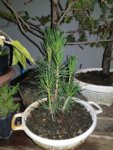
just found my next project - pine clump

Maybe you can find seeds or young scott pines (pinus sylvestris) ? they grow well and the needles can be reduced a lot ! it's good to have many projects
I just tried the same project with red pines (pinus densiflora) seeds this year !

If i can give you an advise, use a lot more trees than necessary, because some of them may die (it's what happened to me) and after a few years of growing, you can choose the best ones
I can probably find white pine seeds... but it will take an eternity to get something like that.
 
I can probably find white pine seeds... but it will take an eternity to get something like that.
It's true :/ Do you know the book : "pines in bonsai" (in french "les pins en bonsai") by ABE kurakichi ? he was a specialist of pentaphylla pines and he wrote that he was doing bonsai for the next generation. For him a 40 Y.O white pine is just starting to get maturity and bark. Anyway i think your projet will take decades to look good with thunberg or scott pine but personnaly i find it nice to cultivate seeds aswell as older trees.

I'd like to find Young pentaphylla forest to see how it becomes years after year. The nursery gardener where i usually buy my young trees from seedings had recently a very nice forest of white pines (not parviflora pentaphylla but i can't remember the exact species) but he didn't want to sell it to me, he wanted to keep it and sell the trees separatly i guess.. i was a little disappointed because it was maybe 10 years old and very nice (a lot of trunks the one near to the others and very nice little needles) a little like this picture (but with more trunks and vertical trunks) ->
IMG_3452.JPG
 
How was the original clump made???
Would an airlayer work at a whorl?
 
How was the original clump made???
Would an airlayer work at a whorl?
Note sure i undestood your question : do you ask "how the bonsai trees were made ?" on the pic you posted first ?

As long as i know airlayering doesn't work with pines, but maybe Japan master can make root grafts. I'm not sure but i think the trees you love have just grown the one near the other and now the are very big and near (and maybe starting to melt/fuse on the roots) and you have the impression it is just 1 tree .. maybe they found this multitrunk tree in nature a few décades ago in a basin of rock, maybe they just put mature trees the one next to the others to do a multitrunk but when i look at the pic i'm not sure that it is 1 tree as the trunks seem to be separated (except the nebari).

Maybe an idea for your project (to save years and years) would be this : to find mature trees (straight scott pines or white pines or thunberg pines) and cut some roots of each nebari of those pines to put them very close the one to the others.. to try to do the same multitrunk as the one on your pic
 
One method is to put a bunch of seed in the same spot in the pot, and let them grow. In nature sometimes a pine cone gets buried just right and a clump of seedlings sprout. Let them grow up several years, then thin to the number you want. You can vary the heights of JBP seedlings the same age by pulling needles early or middle summer. Pull more needles off the ones you want to finish shorter, leave all the needles on the dominant tree. Selective pruning will also be necessary. When repotting, treat the roots as a single root system if the trees are in the correct positions.

Bark for JBP simply takes time, 5 years for the initial hint of bark, 10 years to begin to look like real bark, and something over 25 years for mature bark. No way to rush it, time is all that is needed.

image.jpg
This comment reminded me of this clump of Ponderosas I found growing from what I am guessing was a pine cone that fell in the right conditions one wet spring.
 
I am not sure he is still coming to the forum.
His profile doesn't have a last seen date
 
Cool thread. I’d love for others to chime in with clump projects they’re working on. I’m very interested in making one myself from scratch with JWP I’m starting from seed this year. I’m aware of the challenges this species presents, especially the genetic diversity that result in variable foliage, bark texture, and vigor. I actually find this aspect quite interesting.

My plan is to grow them out for a couple of years to ensure they have the needle and growth characteristics I’m looking for. I know it can take longer than that to be sure, but sometimes it’s immediately obvious when Eastern White Pine genetics have infiltrated. I’d then select the most similar ones to be held together by a string to keep them in place but not disrupt the flow of water and nutrients up their trunks.

After a couple of years of growing as a clump in a pot, I’ll put them in the ground so the fusing happens faster. I have 2 surviving JWP seedlings I’ve field grown for 15 years that were potted in 2024 and 2025. When grown in the ground, non-grafted JWP can put on considerable girth in a relatively short time, even without fertilizing. They are trees after all.

There are so many variables that can cause this project to fail, so right now I’m just hoping I have enough seedlings sprout with decent needle characteristics.
 
Kabudachi are one of my favorite styles. Something I aim to create with my pinus sylvestris.
I have one project of some 2-3 year old saplings I've wired together this year. Which I'll try to remember to photograph tomorrow.

I also have thoughts on attempting to induce backbudding on the first whorl of seedlings, and wiring the internode between the whorl and roots close together/wrapped with roots. Then growing it all out for a good few years.

(Edit: I'll add that I read somewhere that in Japan, pinus parviflora kabudachi are created by making seedling cuttings, effectively removing the internode between the first whorl and roots. Then grown in a high Co2 atmosphere. Potentially utilising fulvic/humic acid... which I don't know so much about. Which promotes lateral buds, opposed to apical dominance.... would love to find this article again)

Here is an example of reducing visual size between roots and first internodes (a submission to the 2026 raft contest)

I'll repeat variations of this process either in this thread or create a new one!
 
Last edited:
I would suggest planting a cone as in nature or planting a number of hand picked seedlings of different sizes. If seedlings you can band then together at the base to aid fusing and root integration. Just be careful not to strangle or girdle where they are banded. If needing to suppress growth of any in the group you can always cut back to a viable branch to shorten and at the same time this will retard trunk thickening of the smaller trees. I'm a bit curious why no one suggested doing this with JRP or a similar American tree as they might lend themselves better to the slightly thinner trunk nature of a clump. 🤔
 
Back
Top Bottom