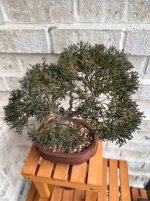
Juniper Dormancy?

oysterowl83

Seedling
Messages
21
Reaction score
63
Location
Atlanta, GA
USDA Zone
8A
Hey everyone!

Just checking in on opinions of winter dormancy on this juniper. It has changed to a very dull green with purplish/brownish tips. Underneath still green (4th photo). Thoughts on its dormancy? Thanks much!

-Anthony
 

Attachments

  • IMG_6269.jpeg
    IMG_6269.jpeg
    264.3 KB · Views: 65
  • IMG_6268.jpeg
    IMG_6268.jpeg
    282.9 KB · Views: 60
  • IMG_6271.jpeg
    IMG_6271.jpeg
    386.1 KB · Views: 50
  • IMG_6270.jpeg
    IMG_6270.jpeg
    260 KB · Views: 64
It’s most likely still dormant but it can take a while for them to green up after breaking dormancy. Where are you located, what has the weather been like? Where do you keep the tree?
 
It’s most likely still dormant but it can take a while for them to green up after breaking dormancy. Where are you located, what has the weather been like? Where do you keep the tree?
Thank you for the response! Atlanta, GA here! It's been in the mid to upper 20's at night, except a few nights in the high teens last week. I keep my trees on a balcony on the flooring, corner, and completely blocked from wind.
 
OK, then I would guess it is still dormant. However with the warm spell we are expecting up here with mid-60s all next week I expect to see more outside trees starting to move. My bald cypress in my greenhouse have swelling buds starting to green up already even though I keep them in a 34-38 degree range at night but they have been getting exposed to highs in the 60s during the day.
 
OK, then I would guess it is still dormant. However with the warm spell we are expecting up here with mid-60s all next week I expect to see more outside trees starting to move. My bald cypress in my greenhouse have swelling buds starting to green up already even though I keep them in a 34-38 degree range at night but they have been getting exposed to highs in the 60s during the day.
Thank you again for your response! I was super concerned that the tree was going in a negative direction, and wanted to confirm dormancy colors, etc.
 
The color is more of a weather indicator than a dormancy indicator.
It's a response to cold temperatures; the plant makes these pigments divert the solar radiation away from its chloroplasts into molecules (like anthocyans) that can take a good shake-up. See it as a pair of molecular sunglasses.
Due to low temperatures, the biological functions are down and letting solar rays hit the relatively expensive chloroplasts would cause them to overload and break (oxidize). That would result in total foliar death or bleaching. So to protect themselves, they make these colorful pigments and push them near the foliar surface.
Pretty cool when you think about it! Because human skin - in principle - does somewhat the same by tanning.

Plants can still grow and be biologically active when these pigments are present, and they stick around for a bit when temperature goes up again. I'm saying this because I've seen people being fooled by it; their plant was out of dormancy for a month but the pigments were still there because of the cold nights.

In younger plants, we see these pigments all over the place, which is why they can range in all different colors in the red spectrum. I haven't looked into the science of it for over a decade, but plants might have picked the red spectrum because that's where infrared is the closest to, the molecules might serve a double function to both divert harmful light and capture infrared to generate some warmth. The part about infrared is speculation on my end.

 
The color is more of a weather indicator than a dormancy indicator.
It's a response to cold temperatures; the plant makes these pigments divert the solar radiation away from its chloroplasts into molecules (like anthocyans) that can take a good shake-up. See it as a pair of molecular sunglasses.
Due to low temperatures, the biological functions are down and letting solar rays hit the relatively expensive chloroplasts would cause them to overload and break (oxidize). That would result in total foliar death or bleaching. So to protect themselves, they make these colorful pigments and push them near the foliar surface.
Pretty cool when you think about it! Because human skin - in principle - does somewhat the same by tanning.

Plants can still grow and be biologically active when these pigments are present, and they stick around for a bit when temperature goes up again. I'm saying this because I've seen people being fooled by it; their plant was out of dormancy for a month but the pigments were still there because of the cold nights.

In younger plants, we see these pigments all over the place, which is why they can range in all different colors in the red spectrum. I haven't looked into the science of it for over a decade, but plants might have picked the red spectrum because that's where infrared is the closest to, the molecules might serve a double function to both divert harmful light and capture infrared to generate some warmth. The part about infrared is speculation on my end.
I concur. Some of my junipers kept their purple until April last year, past the point of new growth extending.
 
Just checking in on opinions of winter dormancy on this juniper. It has changed to a very dull green with purplish/brownish tips. Underneath still green (4th photo). Thoughts on its dormancy? Thanks much!
Why the obsession with dormancy? Is there some pressing reason you need it to be dormant?
 
I’m a little north were it gets slightly colder than ATL. With a little winter protection they can stay greener in winter. I put them on the ground under my bench that still gets light. But for the most part they are pretty hardy so I usually just keep them in the same place all year. Unless we get big 50 degree drops into the low teens or single digits for days or weeks which is rare. Then it is wise to provide protection like a garage or at least on the ground for the amount of time.

It’s the recent cold blast we had that probably made the juniper change color more. I noticed that here at least.
 
The discoloration is called “bronzing”. If you look it up on the web you will find various explanations ranging from dormancy, desiccation and reaction to cold, and physical damage. Almost all sources agree that the trees usually return to their normal green in the spring. I have trees that do it and some that don’t right next to one another, so it apparently has a genetic as well as species specific component and not just generalized cold damage alone.
 
Back
Top Bottom