
Japanese poetry - my favs, poems with trees, etc.

tantric

Yamadori
Messages
61
Reaction score
25
Location
athens, ga
USDA Zone
8a
japanese poetry is known for its brevity. haiku is a 'modern' development, the older tanka (short poem) are 5-7-5-7-7. there's a rare form, the 'long song' or 'naga uta', of which hitomaro is the uncontested master. this is his lament upon losing his wife, which happens to be my favorite poem, period (yes, it's a bit much, i like the raw emotion):

When she was still alive
We would go out, arm in arm,
And look at the elm trees
Growing on the embankment
In front of our house.
Their branches were interlaced.
Their crowns were dense with spring leaves.
They were like our love.
Love and trust were not enough to turn back
The wheels of life and death.
She faded like a mirage over the desert.
One morning like a bird she was gone
In the white scarves of death.
Now when the child
Whom she left in her memory
Cries and begs for her,
All I can do is pick him up
And hug him clumsily.
I have nothing to give him.
In our bedroom our pillows
Still lie side by side,
As we lay once.
I sit there by myself
And let the days grow dark.
I lie awake at night, sighing till daylight.
No matter how much I mourn
I shall never see her again.
They tell me her spirit
May haunt Mount Hagai
Under the eagles’ wings.
I struggle over the ridges
And climb to the summit.
I know all the time
That I shall never see her,
Not even so much as a faint quiver in the air.
All my longing, all my love
Will never make any difference.
-Kakinomoto no Hitomaro

tree trivia: the word 'matsu' can mean 'pine' as in the tree, and 'wait' - almost like english's two meanings for 'pine'

and something warm and cozy to make up for the above:

The nightengale on the flowering plum,
The stag beneath the autumn maple
You and me together in bed,
Happy as two fish in water.
-Anonymous
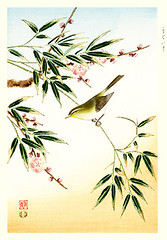
15900203128_cbf56ebc64_m.jpg
 
tree trivia: the word 'matsu' can mean 'pine' as in the tree, and 'wait' - almost like english's two meanings for 'pine'

Actually it does not in written form. Phoenetically yes, but written they are the following characters.
松 Pine, 待つ To wait, there is also 末 latter, later
And even when speaking it would be very easy to distinguish which subject is being discussed.
 
But great poetry and thanks for sharing. Interesting to have two seasons in the last poem...
 
i'm about to get called arrogant again...

perhaps you're referring to modern japanese? 'thanks for sharing'? you're seriously being snide about the two season poem? do you think i don't know that you're being snide about the two season poem?

now, i will school you:


wikipedia:

A kakekotoba (掛詞?) or pivot word is a rhetorical device used in the Japanese poetic form waka. Ths trope uses the phonetic reading of a grouping of kanji (Chinese characters) to suggest several interpretations: first on the literal level (e.g. 松, matsu, meaning "pine tree"), then on subsidiary homophonic levels (e.g. 待つ, matsu, meaning "to wait"). Thus it is that many waka have pine trees waiting around for something.
the particular book i was speaking of, '100 Poems from the Japanese'

fromrexroth.jpg

Refs - do you have JSTOR access? This one is free.
  • Otake, Takashi, and Anne Cutler. "Lexical selection in action: Evidence from spontaneous punning." Language and speech 56.4 (2013): 555-573.

now, wtf is *wrong* with you people? are you lives really so empty that you get some kind of ego boost out of thread crapping? and who the hell are you? you *sell* japanese calligraphy....? i write japanese calligraphy, every day, i use kanji as shorthand in my gardening journal. during three years of intensive study, i was told on several occassion that running script was 'suburashii'. but, pardon me, writing in running script is something i do as everyday part of my life, not some pretentious crap i sell to other wanna Zen(tm) posers on the internet. you couldn't tell the 万葉集 from crabgrass with both hands and a flashlight.
 
Last edited:
You're far from arrogant. You are just a dumb ass. Kakejiku at least responded to your stupid post. Like me now.
Remember me. I'm the original thread Crapper here weirdo! Did you get your blueberry bush wrangled around with your toenail clippers yet? Or has it died.
You are here why? You have no trees. Everytime someone responds to anything you post you "school them" and call them thread crappers. I think you spent too much time in a cell thinking you were learning Japanese when the whole time you should have been trying to become a useful part of society. Because in my opinion you are just useless and wasting air that normal people could be breathing.
So why don't you pack up your paltry little Japanese/American dictionary and run along.
 
Thanks for the schooling on how to say "pine" in Japanese...Being bonsai poser folks we had absolutely no idea. And FWIW, we do bonsai here. Most of us are not all that interested in 18th century Japanese poetry or have only a passing interest in Japanese culture. We're interested in the mechanics and visual art of bonsai. Posting poetry and the like here is like casting pearls before swine. We just don't give a crap about it.

If you can't talk bonsai, you can't really impress us with haiku or obscure Japanese literary references, or Kanji, for that matter. Sorry.

And also FWIW, lashing out at Kakejiku for being a "poser" is kiinda like kicking a puppy. He understands a lot more about bonsai than you do. And no, he wasn't being snide. He was being sincere, which he has always been in his postings here. He noted the inclusion of two seasons in the poem because he has some knowledge about such things, possibly as much as you.
 
Last edited:
wikipedia:

A kakekotoba (掛詞?) or pivot word is a rhetorical device used in the Japanese poetic form waka. Ths trope uses the phonetic reading of a grouping of kanji (Chinese characters) to suggest several interpretations: first on the literal level (e.g. 松, matsu, meaning "pine tree"), then on subsidiary homophonic levels (e.g. 待つ, matsu, meaning "to wait"). Thus it is that many waka have pine trees waiting around for something.
the particular book i was speaking of, '100 Poems from the Japanese'

View attachment 77409

Refs - do you have JSTOR access? This one is free.
  • Otake, Takashi, and Anne Cutler. "Lexical selection in action: Evidence from spontaneous punning." Language and speech 56.4 (2013): 555-573.

now, wtf is *wrong* with you people? are you lives really so empty that you get some kind of ego boost out of thread crapping? and who the hell are you? you *sell* japanese calligraphy....?

i write japanese calligraphy, every day, i use kanji as shorthand in my gardening journal. during three years of intensive study, i was told on several occassion that running script was 'suburashii'. but, pardon me, writing in running script is something i do as everyday part of my life, not some pretentious crap i sell to other wanna Zen(tm) posers on the internet. you couldn't tell the 万葉集 from crabgrass with both hands and a flashlight.

OK, tantric, don't have a tantrum. I really liked your sharing of the Japanese poetry so that is why I replied..

I did not realize the literary device of that word.... So yes, now I understand you are correct that it has a double meaning. Maybe they do the same thing for 書き、下記、夏季、描き etc.

If you had taken ten minutes to learn anything about me, I do not write the calligraphy. My wife does. And she does so with reluctance, because she does not think that she is that good、Even though she has a shihan rank to teach other people how to do Japanese calligraphy with the Shunju Shodokai based in Yokohama, Japan. I also have pieces sent to me by other calligraphers. For example, I am working on one that says 真心館 for a Japanese Buddhist society back East.
And no, I do not know anything about growing bonsai. It is not in my blood, I spend all my time making scrolls, which sometimes has an ancillary use with bonsai....and I feel good when I get to work with some bonsai artists to create displays. I have studied the Gaddou system of display in depth, and I really like how it incorporates the concepts of traditional Japanese arts with how the pieces within the display are classified.

Maybe I should have clarified,

But on the second poem, I was thinking how difficult it would be to use that poem in a traditional bonsai display because there are references to two seasons, and that is something I have not not seen in a poem used with bonsai.

As I stated before, I just should leave for good.
 
i did blow up at you, kakejiku, and i apologize. it's hard to judge tone on the net, and front similar responses i've received in other threads, i assume snark when you meant none. and i assumed you were part of a group without confirming that, and i apologize for that. i'm glad your wife makes money with the calligraphy, i write kanji in my journal to practice. while i was in school i had stacks of graph paper notebooks filled where i'd practiced.

my blueberry is fine, i'm letting him put on growth to thicken his scant little branches. i also have a lilac, a blueberry and a japanese maple i've airlayered. my toenail clippers seem to do fine, though mostly i use them for snipping blight out of my tomatoes. i'm out of this site - y'all can just keep whatever it is you have, i don't want any.
 
Back
Top Bottom