Identifying Juniper Species, Cultivar

MrMiagtree

Sapling
Messages
25
Reaction score
16
Location
Kansas City, MO
USDA Zone
6A
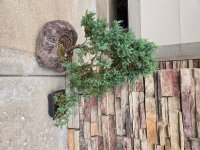
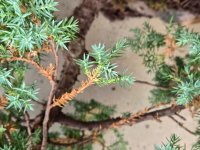
I recently picked upn his juniper on deep discount from a store front going out of business. However, the owner couldn't tell me what type of juniper this is. She thought Chinese, but it has no scaling to the foliage. Any thoughts? Just trying to map out a care plan.
 

Attachments

  • 1000010579.jpg
    1000010579.jpg
    278.2 KB · Views: 48
  • 20251206_134859.jpg
    20251206_134859.jpg
    375.5 KB · Views: 48
  • 20251207_104746.jpg
    20251207_104746.jpg
    297.2 KB · Views: 48
I'm going with juniperus procumbens (not the nana variety) or juniperus chinensis var. Stricta, which is a needled chinensis cultivar.

But my money would be on procumbens since stricta tends to grow more woody faster. Procumbens can have green shoots for almost an entire year sometimes.
 
I'm going with juniperus procumbens (not the nana variety) or juniperus chinensis var. Stricta, which is a needled chinensis cultivar.

But my money would be on procumbens since stricta tends to grow more woody faster. Procumbens can have green shoots for almost an entire year sometimes.
I see what you're saying but this is supposedly an 18 year old tree, with no scaled foliage. The shop owner thinks chinensis, but she's not the one who acquired it. Her son did, and he wasn't present.
 
I'm going with juniperus procumbens (not the nana variety) or juniperus chinensis var. Stricta, which is a needled chinensis cultivar.

But my money would be on procumbens since stricta tends to grow more woody faster. Procumbens can have green shoots for almost an entire year sometimes.
After giving it an inordinate amount of research, I think its procumbens. The foliage arrangement is a close match, and I learned even at this age, if it was always grown in a pot the foliage won't scale.
 
It could just be so that you have a true procumbens.
I feel like the scale type foliage, which is never described in its native range, nor in the first arrivals elsewhere, is a result of hybridization.
I have no proof of this other than the fact that it's not present in the original variety, nor in the wild, nor in the ones imported in Europe and Asia, but only in the ones that have been in the United States.
I believe they have been hybridized with horizontalis or similar junipers, but kept most of the traits of the procumbens.
In older age specimens, some might have gone scaley, and have been reproduced for mass market asexually (cuttings, vegetative propagation).

Still a fun species to work with, very tough plants and a good output of growth. I like them.

 
Back
Top Bottom