
Blue Point Juniper - health question

ACrawl

Seedling
Messages
21
Reaction score
8
Location
Atlanta, Georgia, USA
USDA Zone
8A
Hey everyone.

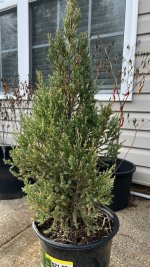
I couldn’t resist, I picked up this blue point juniper today. Notice the browning on some of the tips and branches, should I be concerned?

Would you call this winter burn? I decided to go ahead a grab it because the branches are flexible rather than dried and brittle. Any insight or noticeable concerns?
IMG_8662.jpeg
 
Junipers usually have a slight change of color in the winter, my Itoigawa for example goes a bit purple then bronze. I am not familiar with this specific juniper, but if you could take a closer picture of the brown foliage, we could certainly tell if its winter coloration or a root issue
 
Thanks. Here are some closer pics. If these are difficult to see - I’ll take more in the morning during daylight. IMG_8664.jpeg

IMG_8665.jpeg

Also, I put a moisture meter into the soil. It shows dry down to about 5 inches in the pot, however - my finger tells me it’s moist at an inch or so.
 
Junipers when under- or overwatered tend to drop their tips. Those tips go brown first.
No reason for concern now, but keep track of it. If the issue keeps expanding, review what's going on. Right now, attribute it to past situations you had no control over.

Moisture meters are not great for moisture measurements: they measure electrical signals between the probes and as long as there is water, those will work. But as long as there is water and electricity, those probes will oxidize and break down, obscuring your measurements. You don't know it's failing until you know it's failing.
If you use a regular wooden skewer, you should be able to read it: if it's wet, soil is wet. If it's moist, the soil is moist. If it's dry.. Soil is dry.
I haven't found anything to beat that system.
 
Would you call this winter burn?
It is easy to form the assumption that because conifers keep their foliage through the winter, that they are still actively photosynthesizing. Just because they can photosynthesize in the winter does not mean they do. Conifers slow down but remain active to temps at or slightly below freezing, but once temps get too low, they will close their stomata (the little holes in their foliage that allow transpiration and photosynthesis) and go dormant. It is this dormancy change that you are seeing. In some cases, with some trees or cultivars, the change will be more noticeable and a juniper (for example) will change from a bright green to a dull greyish green, or even a copper or purplish color. This is all normal.

Similar to deciduous trees, you should be most worried about two things: (1) a very early deep freeze in the fall or (2) a cold snap in the spring after the trees have started to wake up. Trees go into and come out of dormancy slowly, and it is a quick change in temps that can harm or kill your trees. A lot of people worry about absolute temperature - when they should focus more on the rate of change of temperature.
 
Back
Top Bottom